HOUSTON — Four volunteers who spent more than a year sealed inside a simulated Mars habitat walked out into the Texas air Saturday, concluding 378 days of isolation designed to help NASA prepare for future human voyages to the moon and the red planet.
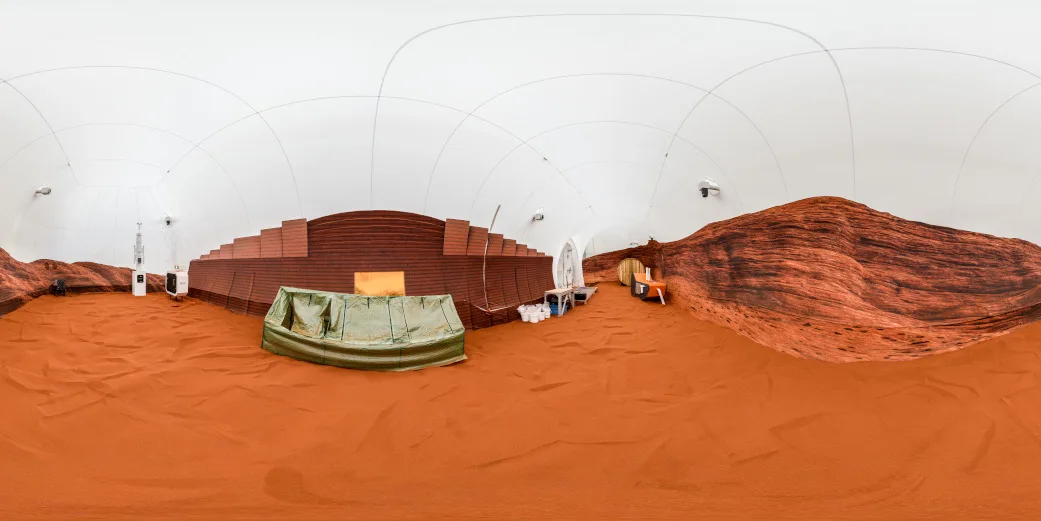
Crew members Ross Elder, Ellen Ellis, James Spicer and Matthew Montgomery departed the 1,700-square-foot enclosure at the Johnson Space Center in Houston, ending the second mission of the Crew Health and Performance Exploration Analog program, known as CHAPEA. The four participants entered the 3D-printed structure on Oct. 19, 2025, NASA said in a press release.
Life inside a 3D-printed outpost
During their prolonged stay, the crew operated under conditions designed to replicate the immense constraints of an interplanetary journey. Living separated from family and friends, the volunteers performed habitat upkeep, exercised, tended to crops and carried out simulated spacewalks that required them to pass through an airlock, according to reports from NASA and Engadget.
Mission controllers subjected the crew to the realistic stressors that space travelers would encounter far from Earth. These hurdles included constrained supplies, strict resource management and artificial transmission lags that mirrored the delay of signals sent across millions of miles of deep space, NASA stated.
NASA planned a ceremony to mark the crew’s emergence Saturday afternoon, featuring remarks from Johnson Space Center Director Vanessa Wyche, astronaut Jack Hathaway and each of the four participants. The event was streamed online, with media gathering outside the hangar housing the facility to see the crew step outdoors for the first time in more than a calendar year.
Paving the road to Mars and the moon
The health and operational findings gathered during the 378-day mission are slated to inform NASA’s ongoing exploration initiatives, including the Artemis campaign and future lunar bases. Long-duration surface stays pose significant risks, ranging from nutritional shortfalls to mental fatigue and behavioral friction.
Agency researchers intend to evaluate the data to refine food systems, balance daily schedules, assess communication bandwidth demands on the Deep Space Network and enhance medical protocols. In addition, the findings will assist flight physicians and behavioral specialists in designing medical care and psychological interventions for crews operating without real-time emergency help from Earth, NASA noted.
“We want to develop permanent habitation on the moon, and learn how to do that really well,” Sara Whiting, a scientist with NASA’s Human Research Program, told TIME for Kids. “We can then take that and translate it to Mars.”
Whiting explained that emergency resupply flights would be exceedingly difficult during a genuine expedition to Mars, making advance terrestrial testing essential to keep future astronauts safe, healthy and successful.
What lies ahead for space analogs
Saturday’s exit marks the completion of CHAPEA’s second trial run. NASA initially sought applicants for the initiative in 2023, and the first group entered the simulated habitat in June of that year, Engadget reported.
Looking ahead, the agency has already opened the application window for another yearlong project, the Moon and Mars Exploration Analog. That upcoming mission, which could launch as early as August 2027, will merge components of the CHAPEA program with other flight simulation methods, according to NASA and TIME for Kids.
In the coming test, four selected recruits will spend a full year divided between two facilities at the Johnson Space Center: one recreating the tight interior quarters of a spacecraft and the other modeled after an extraterrestrial surface habitat. NASA aims to use the continuous data stream from these long-term isolation studies to ensure future astronauts can endure years away from Earth.