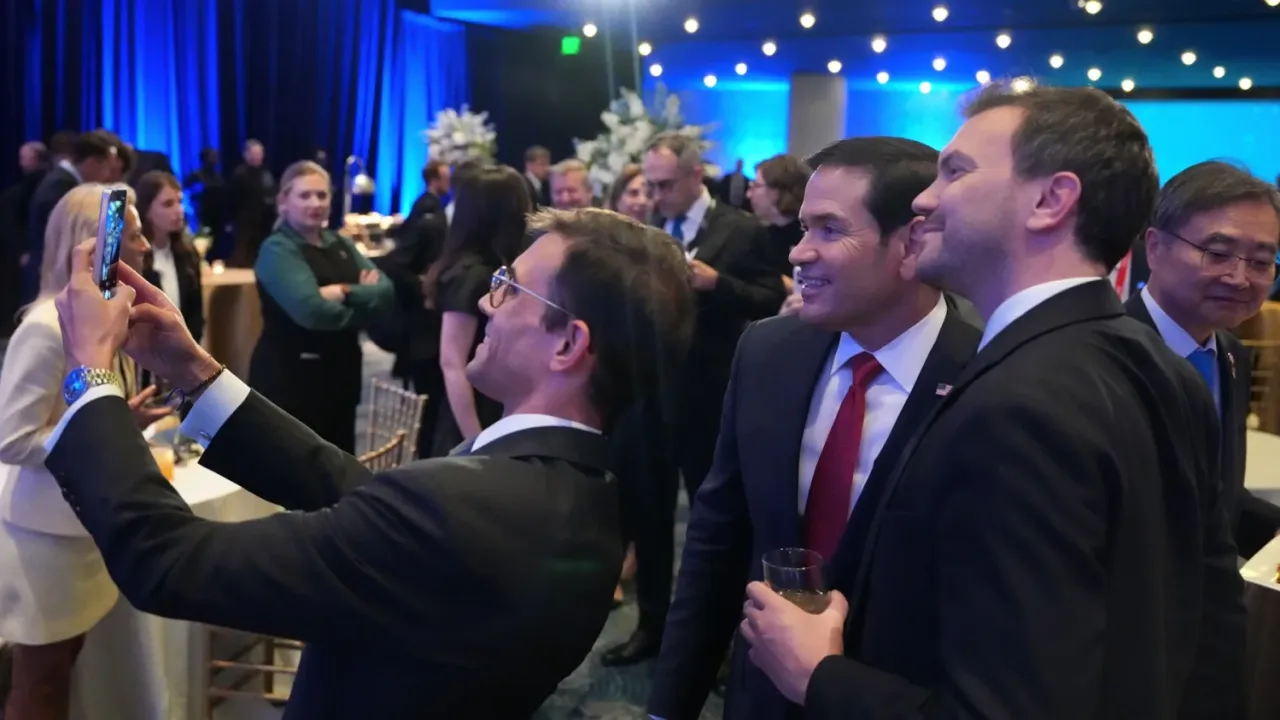
ATLANTA — The United States canceled the traditional opening group photograph at a gathering of Group of 20 foreign ministers on Friday after several Western allies refused to appear alongside Russian Foreign Minister Sergey Lavrov.
Secretary of State Marco Rubio decided to scrap the ceremonial snapshot, often referred to as a “family photo,” after approximately one-third of the attending delegations indicated they would boycott or walk away from the stage. An American official stated that the decision was made to prevent a ceremonial photo opportunity from morphing into a diplomatic distraction, allowing officials to concentrate on substantive discussions.
Allies draw a line over Russia’s war
The resistance was spearheaded by European governments, Britain and Australia, all of which insisted they would not normalize Moscow’s full-scale assault on Ukraine. Russia launched its invasion in 2022 and maintains control over about one-fifth of Ukrainian territory.
German Foreign Minister Johann Wadephul stated before Friday’s opening session that under no circumstance would European partners appear in a group picture with Lavrov because “there is no normality with Russia,” as reported by the German news agency dpa. British Foreign Secretary Ed Miliband affirmed a similar stance, noting that the United Kingdom has avoided that type of engagement with Moscow for years.
Australia’s foreign minister, Penny Wong, used the opening session to directly condemn Russia’s actions in front of Lavrov, emphasizing that the war has disrupted global markets and harmed food security. A spokesperson confirmed Australia backed the American decision to drop the photo.
Polish Deputy Prime Minister and Foreign Minister Radosław Sikorski, attending as an invited guest, called the move the right choice, remarking that multiple diplomats had no desire to stand next to Russia’s envoy.
Deep divisions over trade and attendance
Despite the standoff, Rubio opened the ministerial meeting in Atlanta by warning colleagues that the world faces interconnected economic and geopolitical perils. “We are in a critical moment,” Rubio said, citing severe threats confronting international trade and global stability.
The gathering takes place amid heightened friction between Washington and its traditional partners. President Donald Trump recently suspended several sanctions on Moscow and agreed to import Russian diesel to curb domestic fuel prices ahead of Tuesday’s midterm elections. Ukrainian President Volodymyr Zelensky criticized that agreement, labeling it a gift to Russian President Vladimir Putin.
At the same time, the administration has faced questions over its guest list. Ukraine was not invited to Atlanta, which U.S. officials described as an effort to limit the room to formal participants. However, the United States also excluded founding G20 member South Africa following bilateral disputes, while inviting Poland. South African officials reiterated that their absence was involuntary.
Dim hopes for a consensus
The discord in Atlanta makes the adoption of a joint ministerial communique on Saturday highly unlikely. Diplomatic sources told AFP that Washington plans to release a chair’s summary instead.
Discussions are further complicated by the conflict in the Middle East, where U.S. and Israeli strikes on Iran prompted Tehran to shut the Strait of Hormuz, driving global energy costs upward. Delegations must now determine whether they can bridge these divides before President Trump hosts world leaders for the G20 summit in Miami this December.