Telescopes tracking the interstellar comet 3I/ATLAS have uncovered signs of ancient chemistry that could predate the formation of the sun by billions of years, according to newly published scientific analyses. The findings offer a rare glimpse into the frigid nursery of an alien planetary system.
Detected in July 2025 by a NASA-funded survey telescope in Chile, 3I/ATLAS is only the third confirmed object from outside the solar system ever observed by astronomers. Traveling on an unbound hyperbolic path, the comet made its closest approach to the sun around Oct. 30, 2025, at a safe distance of roughly 130 million miles before heading back toward interstellar space.
Pristine chemistry from deep time
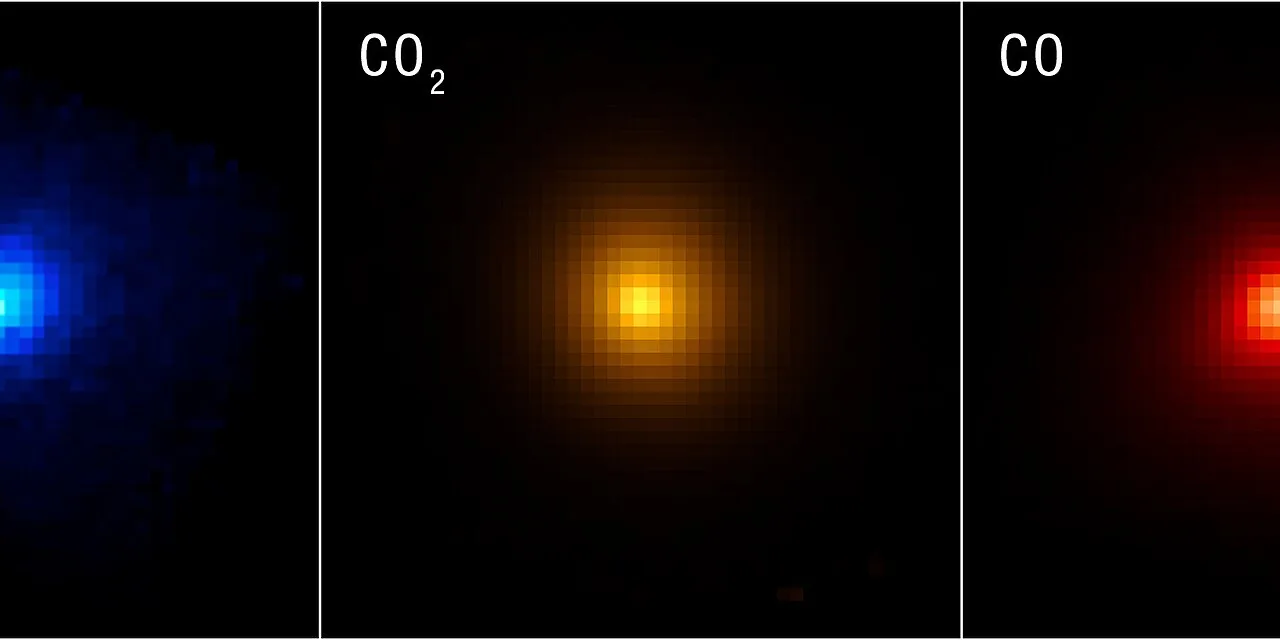
As solar warmth baked the frozen traveler, sensitive instruments aboard the James Webb Space Telescope examined the vapors venting from its nucleus. A study published in Nature Astronomy by researchers with NASA’s Solar System Exploration Division analyzed the comet in late December 2025, when it was cruising through the asteroid belt between Mars and Jupiter.
Scientists scrutinized the comet’s deuterium-to-hydrogen ratio in methane, comparing normal hydrogen with its heavier isotope. The team found that 3I/ATLAS holds far higher deuterium concentrations than any known body in our solar system, boasting 13 times the ratio recorded in comet 67P/Churyumov-Gerasimenko, ScienceAlert reported.
Combined with low levels of carbon-13, the isotope signature points to an origin in an intensely cold, radiation-bathed cloud at roughly minus 440 degrees Fahrenheit. The researchers noted that this chemistry likely formed in an ancient protostellar environment that lacked heavier elements forged by later stellar generations. The material may have assembled up to 7 billion years before our own solar system began taking shape.
A separate team led by researcher Cristina A. Thomas examined mid-infrared observations gathered by the James Webb Space Telescope post-perihelion, Astrobiology Web reported. Their analysis detected overwhelmingly amorphous silicates—primarily unheated pyroxene grains—with a crystalline fraction capped below 5.3 percent. The authors noted that this lack of crystal structure demonstrates the comet survived with minimal thermal cooking after it condensed.
The mystery of surface erosion
While the chemical data suggest an ancient origin, astronomers face another puzzle: deciding how much of the sampled material is truly pristine rather than altered during its long voyage through interstellar space.
According to research published in the Monthly Notices of the Royal Astronomical Society by Tessa T. Frincke and Darryl Z. Seligman of Michigan State University, the comet sheds significant material under solar heating. Frincke and Seligman calculated that gas production alone stripped away between 5.6 and 17.2 feet of surface material, The Watchers reported. Accounting for escaping dust raises the estimated erosion depth past 33 feet, representing up to 1.25 percent of the comet’s total mass.
However, prior modeling led by Romain Maggiolo indicated that galactic cosmic rays can chemically alter comet ices down to depths of 49 to 66 feet over eons. Because the estimated solar erosion did not clearly exceed that altered boundary layer, researchers cannot yet verify whether Webb’s spectrographs sampled completely shielded interior material or a surface transformed by deep-space radiation.
Meanwhile, observations led by the Southwest Research Institute using Webb’s near-infrared spectrograph revealed fine water-ice grains mixed with dust, sharing striking spectral traits with trans-Neptunian objects at the outer rim of our own solar system, Universe Space Tech reported. As 3I/ATLAS recedes into the dark, scientists continue to process lingering observational data to determine whether this visitor is an exotic anomaly or a typical artifact of planet formation across the galaxy.