PASADENA, Calif. — NASA has restored communication with Voyager 1 after the distant spacecraft inexplicably went silent for two days in interstellar space, space agency officials reported.
The Deep Space Network, a global array of massive ground antennas used to track deep-space missions, failed to detect any radio signal from the probe during scheduled check-ins on Oct. 18 and Oct. 19. The communications dropout sparked concern at NASA’s Jet Propulsion Laboratory in Southern California, but the probe automatically reestablished contact on Oct. 20 before engineers could transmit emergency commands.
A switch to backup thrusters
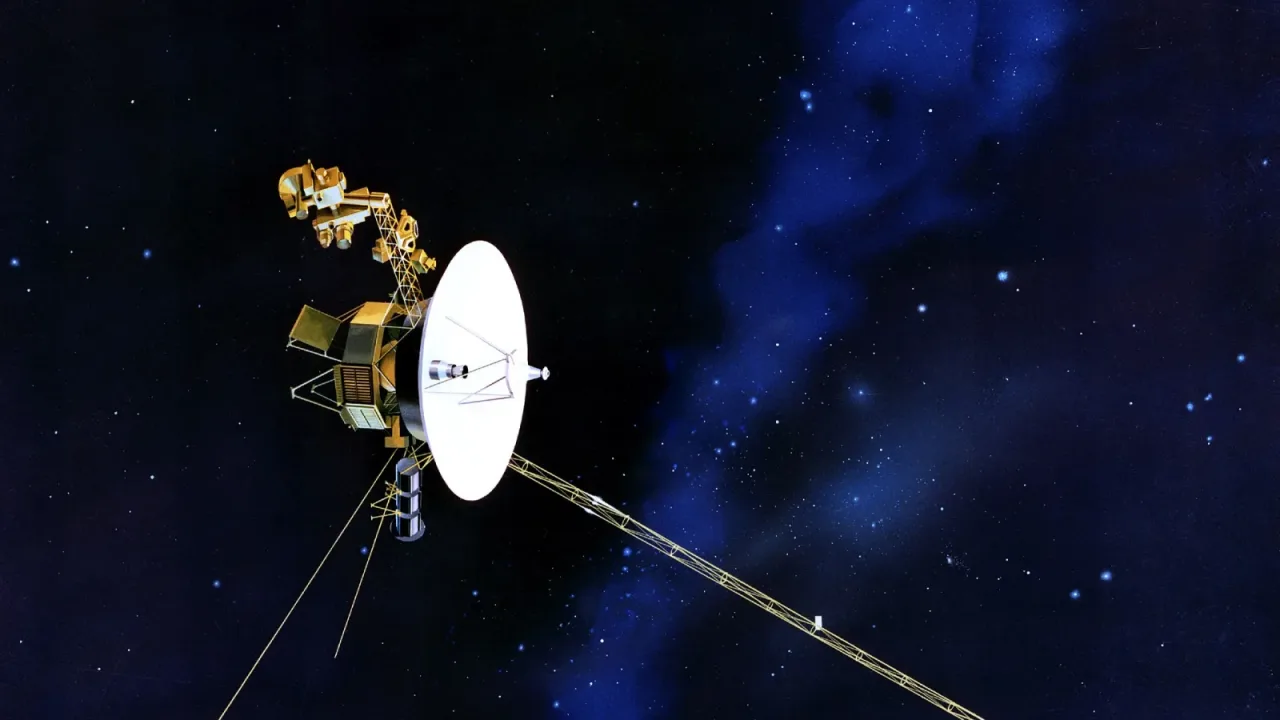
Voyager 1, currently cruising roughly 16 billion miles from Earth at 38,000 mph, appears to have triggered its internal safety software. Mission engineers discovered that one set of thrusters shut down unexpectedly, prompting the onboard computers to activate a backup set. The thrusters are vital small engines responsible for steadying the craft and keeping its high-gain antenna oriented toward Earth.
When onboard computers detect an anomaly in active thrusters, preprogrammed fault protection routines place the probe into a safe mode, pausing routine activity to preserve the vehicle. What prompted the original thruster shutdown remains under investigation, NASA said.
“This is the first time we’ve seen the spacecraft do something like this, but we are also at a point in the mission where we have to expect the unexpected,” Kareem Badaruddin, Voyager mission manager at JPL, said in a statement. “We’re relieved to be back in contact with Voyager 1 and are eager to understand what happened.”
NASA reported that communications have remained steady since the signal returned, though flight controllers anticipate additional technical hiccups between now and summer 2027.
Managing a fading nuclear heartbeat
Voyager 1 and its identical twin, Voyager 2, launched in 1977 to survey the outer solar system. Both craft crossed into interstellar space — the expanse outside the solar bubble known as the heliosphere — with Voyager 1 reaching that threshold in August 2012 and Voyager 2 following in November 2018. They remain the only operational human-made probes exploring interstellar space directly.
Keeping the vintage hardware operational has become an increasingly delicate balancing act. Both probes rely on radioisotope thermoelectric generators that convert thermal energy from decaying plutonium into electrical power. That power supply depletes by roughly four watts each year, leaving razor-thin margins and forcing controllers to switch off heating elements and scientific instruments over decades of travel.
To prevent having to turn off another science tool before summer 2027, the Voyager team executed a complex maneuver nicknamed the “Big Bang” in September. Flight controllers turned off three devices and simultaneously engaged three lower-power alternatives on Voyager 1, mirroring an operation completed on Voyager 2 six weeks prior. The simultaneous transition was necessary because the swapped equipment generates warmth that keeps the spacecraft functioning in the extreme cold of deep space.
Reports vary slightly on how many scientific sensors remain active after recent power cutbacks, with Mashable reporting three operational instruments — the Cosmic Ray Subsystem, Magnetometer, and Plasma Wave Subsystem — while European astronomy outlet yourweather.co.uk reported the probe is down to two active science tools following the recent shutdown of a low-energy particle sensor.
Reaching the one light-day milestone
Even as engineers analyze the thruster glitch, Voyager 1 is fast approaching a historic milestone on Nov. 18, when it is projected to reach exactly one “light-day” from Earth — roughly 16.09 billion miles away.
At that unprecedented distance, a radio signal traveling at the speed of light requires 24 hours to journey from Earth to the probe, and another 24 hours for the craft’s telemetry to make the return trip.
“If you want to say ‘hello’ to Voyager, you send your message and then you go home and you wait two days before you finally get a response,” Suzanne Dodd, Voyager project manager at JPL, said.
NASA stated that passing one light-day will not physically alter the probe’s surroundings or operational status, but it stands as a symbolic marker of the extreme distance reached by humanity’s longest-running space exploration mission.