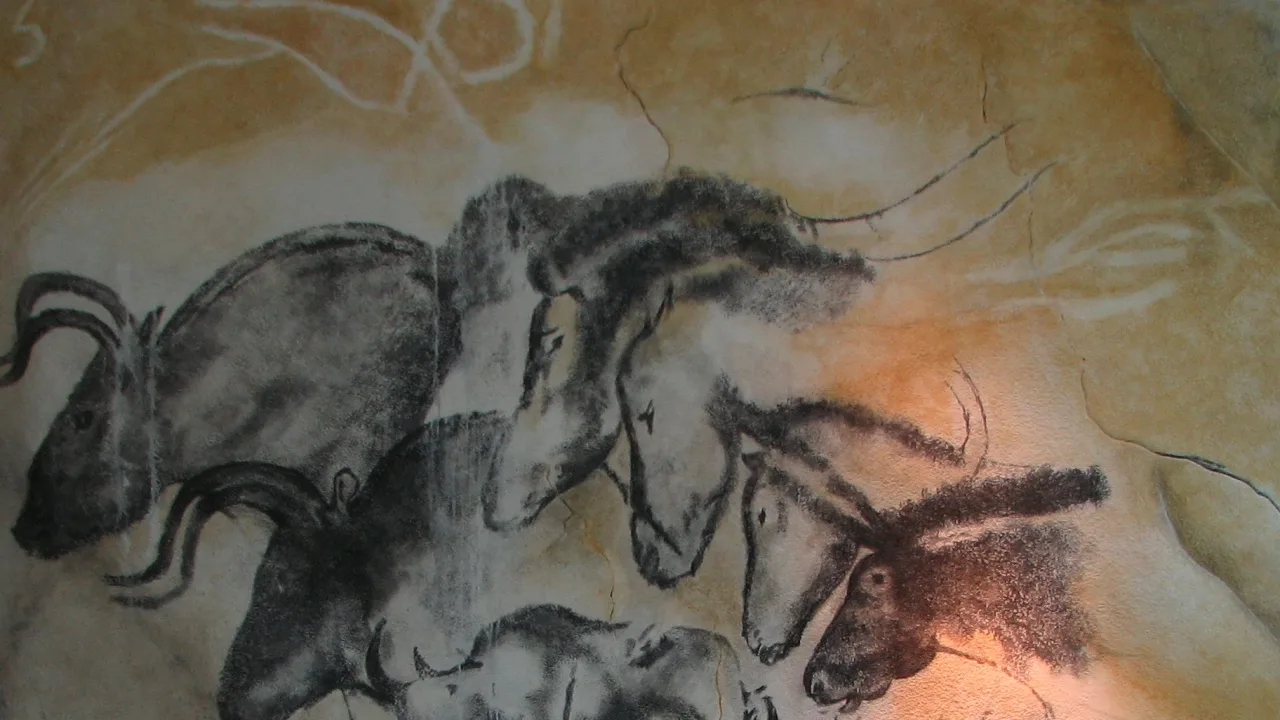
Deep within the limestone corridors of southeastern France, an invisible shield of rock has quietly guarded some of the earliest artistic creations in human history. Researchers using specialized ultraviolet scanning equipment have identified a thin, natural calcite coating that covers 37,000-year-old charcoal illustrations in Chauvet Cave, according to findings published in the scientific journal ACS Omega.
The study, conducted by scientists from Sorbonne University and the French National Center for Scientific Research, explains how these Ice Age depictions of horses, lions, and bison survived across dozens of millennia in near-pristine condition without vanishing beneath heavy subterranean mineral deposits.
Scanning from a careful distance
Chauvet Cave was sealed off by multiple rock collapses during the Upper Paleolithic era, remaining untouched until its rediscovery in the 1990s. Because delicate human and animal footprints still mark the cave floor, authorities restrict visitors and scientists to narrow, protective footpaths. These rules prevent researchers from making physical contact with the walls and keep them between three and 20 feet away from the art.
To analyze the fragile surfaces without disturbing them, the research team engineered a portable ultraviolet fluorescence spectrometer, Sci.News reported. Mounted on a carbon-fiber pole with a fiber-optic bundle and an ultraviolet light source, the device allowed scientists to beam light at the decorated walls from about eight feet away inside the cave’s chilly, humid interior.
Under normal conditions, limestone bedrock and calcite crusts appear chemically nearly identical, confounding conventional diagnostic tools. However, trace organic impurities trapped within the minerals emit distinct colors when illuminated by ultraviolet rays. While charcoal absorbs the ultraviolet beam, the surrounding calcite layers radiate a faint blue glow.
“Our methodology is much like forensic investigation,” Dr. Philippe Walter, the study’s lead author, told Sci.News. “We examine every piece of evidence to decode the techniques of prehistoric artists and understand how the paintings have been preserved over time.”
Natural varnish and scorching torches
Measurements taken along the cave’s famed Horses panel revealed that mineral-rich water flowing across the limestone left behind a see-through layer of calcite directly on top of the black charcoal sketches, Archaeology News Online Magazine reported. Scientists concluded that this transparent glaze functioned like an organic varnish, locking the charcoal in place before heavier sediment could obliterate it.
The scan also revealed that the relationship between the human artists and the surrounding geology was complex. In the cave’s Alcove of the Lions, mineral buildup varied noticeably. The charcoal markings appeared to act as barriers that altered how calcium carbonate crystallized across the bare stone.
Furthermore, researchers detected an unexpected orange fluorescent glow underneath specific charcoal strokes and around marks left by torches. Laboratory experiments showed that only stone subjected to direct heat produced that distinct spectral signal, suggesting that prehistoric illustrators pressed glowing or burning charcoal against the wall, searing the rock beneath their artwork.
Preservation and future technology
The research was backed by Sorbonne University, the French Ministry of Culture, and the French National Centre for Scientific Research. While the new spectroscopic approach offers a major leap forward, team members noted that variations in impurity levels make estimating the exact thickness of the mineral glaze difficult.
Beyond helping conservators monitor the stability of ancient European rock shelters, researchers said the noninvasive technique holds potential far beyond archaeology. According to the study authors, the scanning technology is already being adapted for forensic investigations and deployed in an ongoing project to detect micro-organism biofilms aboard the International Space Station.