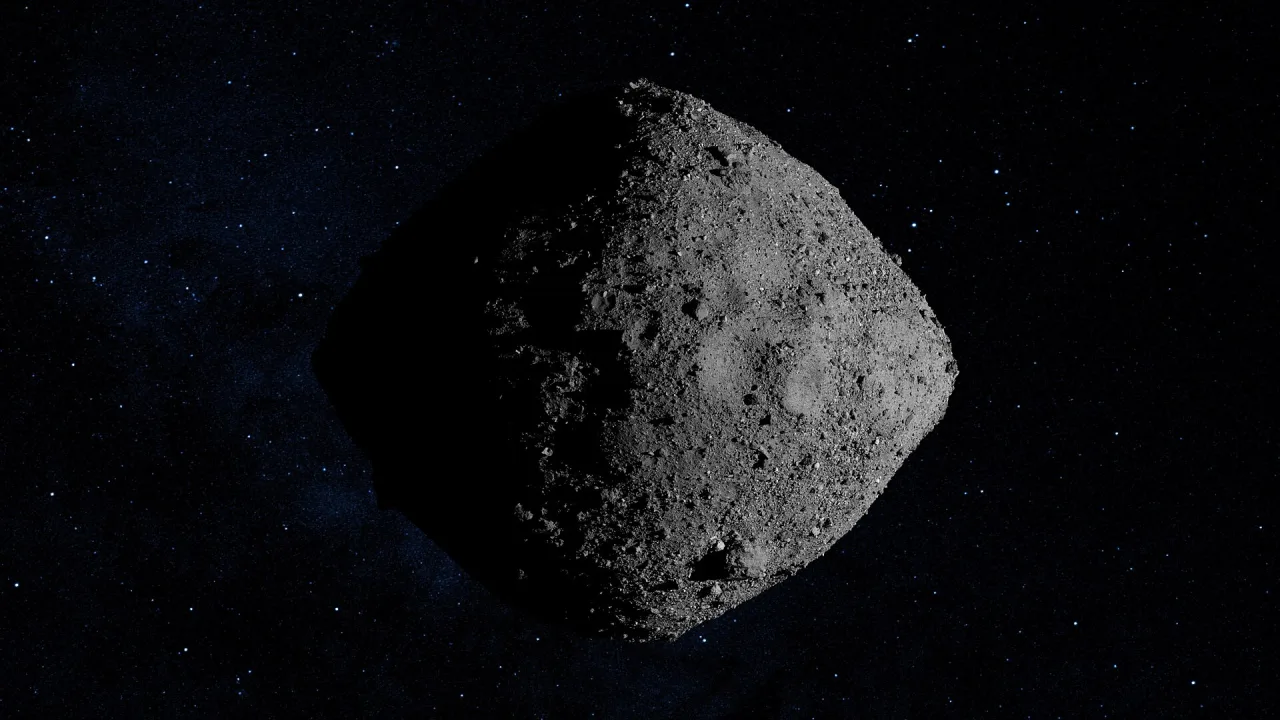
HOUSTON — Laboratory analyses of pristine fragments returned from the near-Earth asteroid Bennu are reshaping how planetary scientists view the origins of the solar system while solving a stubborn puzzle about the space rock’s surface, according to two new studies.
NASA’s OSIRIS-REx spacecraft delivered approximately 120 grams of material to Earth in September 2023 after collecting it from Bennu’s rugged terrain. Small allocations of the 4.5-billion-year-old cargo were distributed to laboratories worldwide, allowing researchers to study the extraterrestrial material without atmospheric weathering.
A hybrid birthplace shaped by Jupiter
In a study published in Science Advances, researchers at ETH Zurich examined the isotopic ratios of iron, titanium and chromium in a half-gram sample. The team discovered that Bennu shares a nearly identical chemical signature with the asteroid Ryugu and rare carbon-rich specimens known as CI meteorites, Science Daily reported.
Scientists long suspected that primitive, carbon-heavy asteroids took shape far out in the frozen fringes of the solar system where comets originated. The isotopic evidence instead indicates that Bennu’s raw ingredients gathered near the water-ice line, the boundary in the early protoplanetary disk where temperatures dropped enough for water vapor to condense into solid ice.
At that frontier, dust drifting from both the inner and outer solar system mixed together as ice grains acted like cosmic glue. Researchers determined that the rapid birth of Jupiter, which grew within approximately one million years of the Sun’s formation, acted as a physical barrier. Jupiter’s gravity blocked larger debris from crossing its orbit but allowed fine dust to pass through and blend thoroughly near the ice line.
“Bennu is a hybrid: the material does not clearly match either the inner or the outer Solar System,” said Maria Schönbächler, a professor of isotope geochemistry at ETH Zurich. She noted that the material provides an exceptional record of the original elements that ultimately formed rocky worlds like Earth.
Internal fractures explain rapid temperature swings
A companion study published in Nature Communications resolved a separate paradox regarding the physical behavior of Bennu’s surface rocks. Telescopic observations collected before the spacecraft’s arrival showed the asteroid displayed low thermal inertia, meaning its surface absorbed and radiated heat very quickly, resembling fine sand rather than solid rock.
When OSIRIS-REx arrived in 2018, however, mission cameras revealed an asteroid densely blanketed by large boulders instead of fine dust. Scientists at the University of Arizona, NASA’s Johnson Space Center and Nagoya University in Japan evaluated returned rock fragments using laser testing and three-dimensional X-ray computed tomography.
To avoid terrestrial contamination, technicians sealed the samples in airtight containers inside nitrogen-filled glove boxes at Johnson Space Center before running the scans. The three-dimensional imaging demonstrated that the rocks contain substantial pore space along with extensive internal fracture networks.
Computer simulations revealed that these pervasive microscopic cracks severely impede heat transfer across large boulders, allowing them to gain and lose warmth at rates previously thought impossible for solid stone.
“They’re really cracked up, and that was the missing piece,” said Andrew Ryan, a researcher at the University of Arizona who led the thermal analysis team.
What researchers are investigating next
The findings give astronomers a calibrated benchmark to interpret infrared heat measurements from unvisited asteroids across the solar system. Meanwhile, geochemists are seeking additional specimens to verify if Bennu’s hybrid chemical signature extends to other primitive bodies.
Japan’s space agency, JAXA, is preparing to launch a robotic sample-return mission to the Martian moon Phobos at the end of October 2026. Those samples are scheduled to arrive on Earth in 2031, providing another direct test of how planetary matter migrated across the solar system billions of years ago.