Engineers on Monday will begin assembling four colossal particle detectors a mile beneath the Black Hills of South Dakota, advancing what scientists call the largest U.S. Department of Energy experiment on American soil.
The project, known as the Deep Underground Neutrino Experiment, or DUNE, is housed at the Sanford Underground Research Facility in Lead, South Dakota. The subterranean laboratory occupies the former Homestake gold mine, where caverns blasted from solid rock have now been cleared to study elusive subatomic particles called neutrinos, The Guardian reported.
Firing particles through the Earth
Operated by Fermi National Accelerator Laboratory, located near Chicago, DUNE will study particles generated at Fermilab and directed through 800 miles of rock to South Dakota. Because neutrinos rarely interact with other matter, the beam requires no tunnel and passes seamlessly through the Earth’s crust.
Neutrinos, often nicknamed “ghost particles,” are the most common matter particles in existence, second overall only to particles of light, The Guardian reported. They exist in three varieties, known as flavors, and spontaneously shift from one type to another while in transit.
Researchers hope observing these oscillations will provide clues about fundamental physics beyond the Standard Model, including the ordering of neutrino masses and why the universe came to be dominated by matter rather than antimatter.
“It’s like building a ship underground,” Prof. David Newbold of the UK’s Science and Technology Facilities Council told The Guardian, noting that the United Kingdom serves as the primary international partner on the project.
Enormous chilled detectors
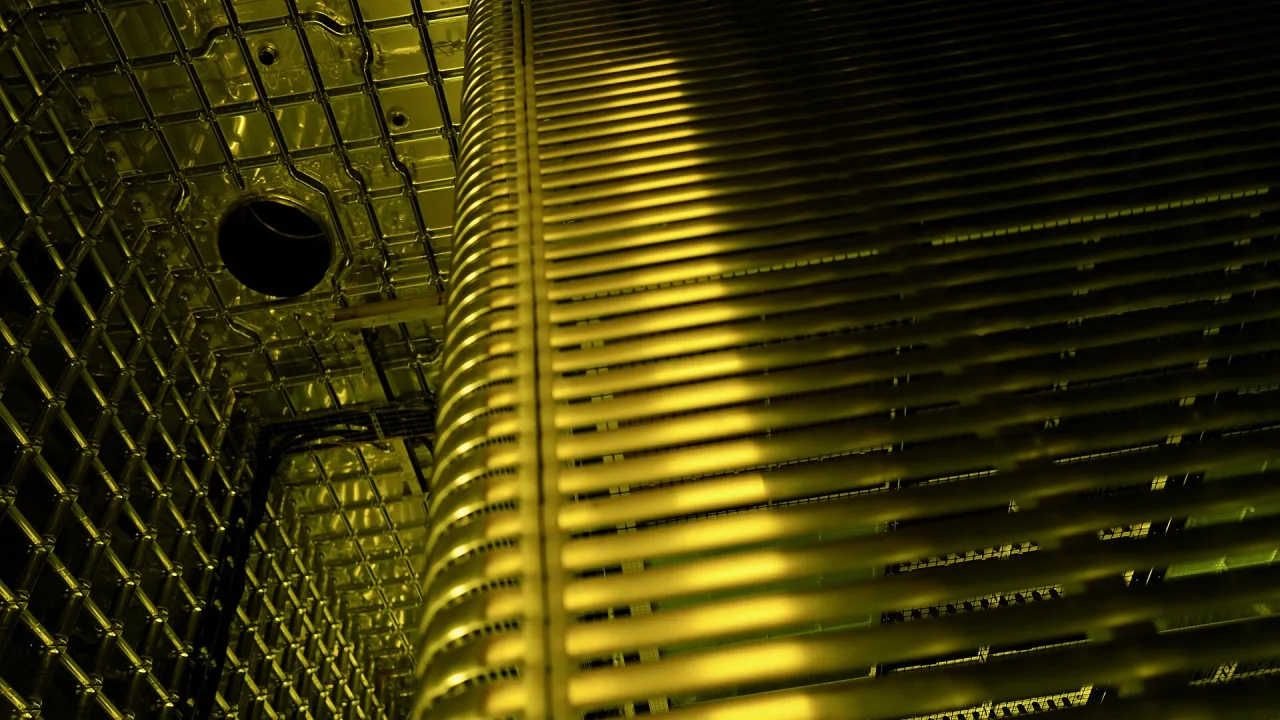
To catch the fleeting particles, workers will assemble four detectors reaching up to five stories in height inside the deep caverns. The finished units will hold a combined 70,000 tons of liquid argon chilled to roughly minus 363 degrees Fahrenheit, according to news reports.
When a neutrino strikes an argon atom, the collision creates a brief flash of light and an electric charge that sensors record.
The project relies heavily on international contributions. The European Organization for Nuclear Research, known as CERN, provided over 5,000 tons of structural steel for the detector cryostats, Newswise reported. Jim Kerby, the project director for Fermilab, told Newswise that the contribution marked the first time CERN supplied infrastructure to an effort outside of Europe.
The assembly of the massive detectors is slated to take nearly three years, with an additional year required to fill them with liquid argon, The Guardian reported.
Meanwhile, Fermilab is completing an upgrade to its accelerator complex in Illinois called Proton Improvement Plan-II. That facility will generate the beam once both locations are fully prepared.
What comes next
The installation marks the latest evolution for the historic mining town. In the 1960s, physicist Ray Davis used a tank of dry-cleaning fluid deep in the Homestake mine to make the first detection of neutrinos from the sun. The mine closed in 2001 before being converted into the current research complex, which also hosts dark-matter experiments.
Data collection from DUNE is scheduled to begin in early 2030, according to Newswise. Researchers say the far detector will eventually operate alongside a movable near detector at Fermilab to measure the beam both before and after it travels across the continent.