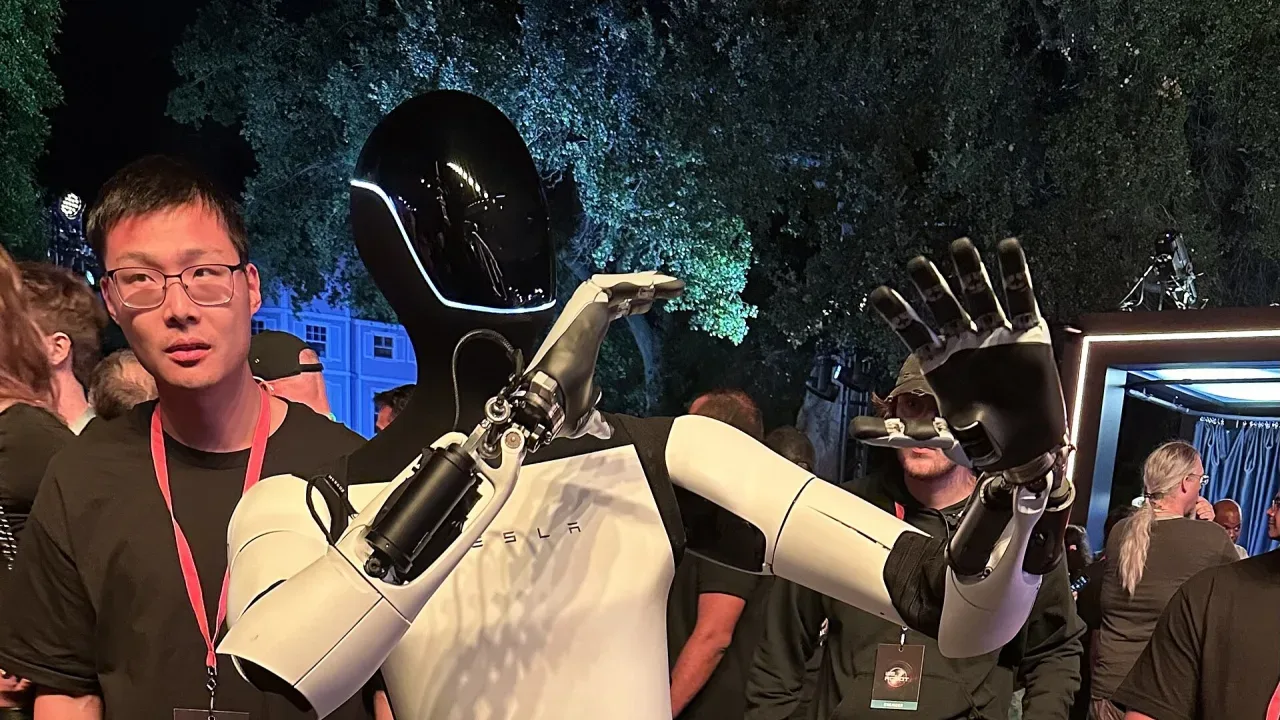
Tesla has initiated early production of its Optimus humanoid robot at its manufacturing facility in Fremont, California, the company announced Wednesday, even as heavy investments in robotics and artificial intelligence contributed to a 43 percent drop in third-quarter profit.
The automaker revealed in its shareholder report that units now being assembled represent the first commercial-grade versions produced by the company. Tesla converted manufacturing floor space previously used for electric vehicle assembly to accommodate the robot line, according to reports from TechCrunch and Business Insider.
Early Assembly and Scaling Ambitions
Tesla stopped building its Model S and Model X vehicles at the Fremont plant earlier this year to clear space for a line intended to eventually assemble one million robots annually, Business Insider reported. The company is also constructing a separate facility in Austin, Texas, planned for an eventual annual capacity of 10 million units.
Speaking on a quarterly conference call, Chief Executive Officer Elon Musk called the Fremont milestone “early production” and warned investors that the manufacturing ramp would face hurdles. Musk said the process would be “somewhat bumpy because it is such a radically new product.”
“There’s still some things we need to tweak about the design, because you need to deliver a robot that is safe and reliable and has long duration,” Musk said, noting “it can’t, like, wear out after a month.”
Musk stated that the company expects to reach a pace of 20,000 robots per week by the end of 2027, with deliveries to commercial buyers projected to begin late next year, Business Insider reported. Developing dexterous hands remains among the primary mechanical challenges, Musk said, adding that Tesla is establishing an “Optimus Academy” where machines will execute tasks to produce machine learning training data. The company plans to incorporate its AI5 processor into the robots next April, which Musk indicated would substantially increase computing power.
Robotics Spending Weighs on Earnings
The aggressive push into robotics and autonomous systems took a significant financial toll on Tesla’s third-quarter results. Net income dropped to $787 million, down 43 percent from the $1.37 billion posted during the third quarter of 2025, TechCrunch reported. Lower revenue from regulatory credits also crimped bottom-line performance.
Tesla brought in total revenue of $28.04 billion for the quarter, largely unchanged from $28.09 billion during the same period in 2025 and lower than the $28.23 billion reported in the preceding quarter. Electric vehicle revenue stayed flat year-over-year at $20 billion, with the automaker delivering 486,532 cars. Energy division sales fell 16 percent to $2.8 billion, a drop the company attributed to tariff-related customer refunds.
A bright spot came from Tesla’s services division, which includes subscriptions to Full Self-Driving driver-assistance software. Services revenue surged 33 percent year-over-year to $4.6 billion, generating a record $734 million in gross profit, TechCrunch reported.
Autonomous Software Timelines Shift
While executives reiterated confidence in self-driving technologies, the company postponed its deployment forecast for an unsupervised version of Full Self-Driving. Ashok Elluswamy, Tesla’s vice president of AI software, said the company anticipates releasing software updates enabling customer vehicles to function as robotaxis around the second quarter of next year. That guidance pushed back an earlier estimate by Musk, who had suggested the capability would likely arrive in late 2026.
Tesla faces growing pressure in both autonomy and robotics. Competitors such as Agility Robotics, Figure AI, 1X, Sunday Robotics and Weave Robotics are already moving humanoid systems into warehouses, factories and domestic testing environments, Business Insider noted.
Musk indicated that Tesla plans to release updated video footage of the redesigned Optimus within the next two months, while the broader timeline for commercial adoption will depend on how quickly engineers resolve software and reliability challenges.