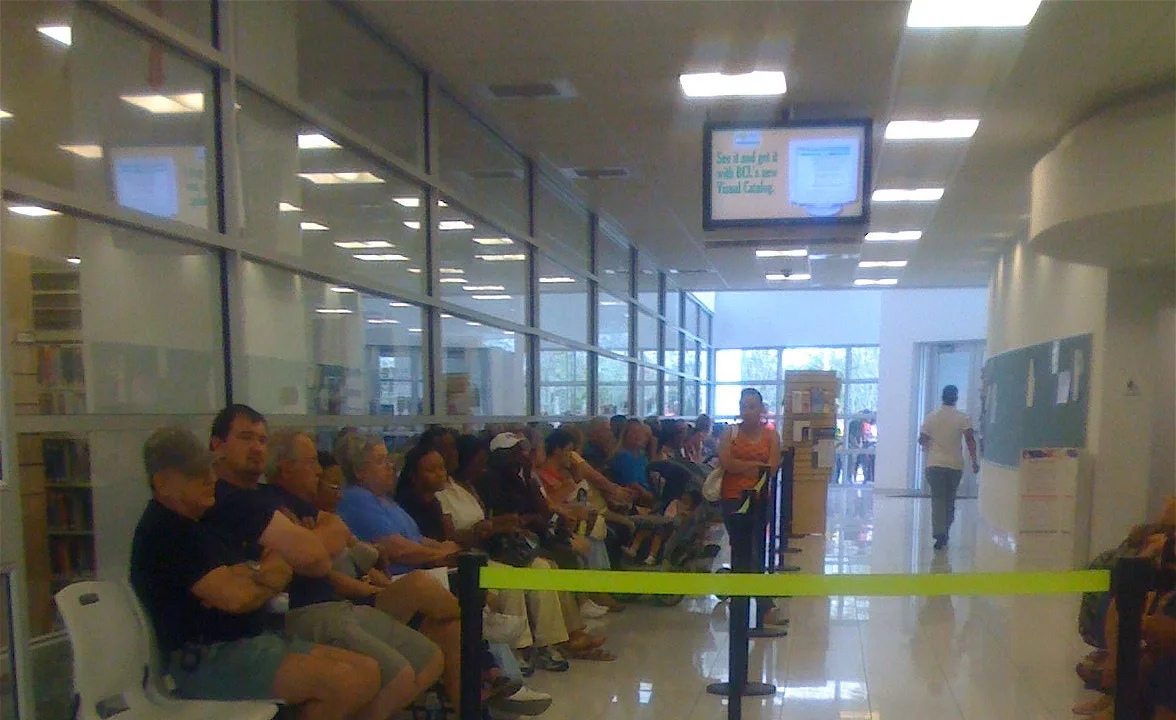
A record-shattering opening day of early voting in Travis County, Texas, surpassed turnout levels from every midterm cycle this century, according to state election figures reported by KUT.
Nearly 41,000 people cast their ballots on Monday, Oct. 19, accounting for roughly 4.3 percent of the county’s 952,713 registered voters, KUT reported from Texas Secretary of State data. That opening-day surge exceeded the 2.8 percent turnout seen on the first day of early voting in the 2022 midterms, as well as the 4.14 percent recorded during the 2018 midterm election.
Travis County Clerk Dyana Limon-Mercado said officials anticipated a significant turnout after the primary election earlier this year delivered the highest early voting participation in any primary since 2008, according to KUT.
Limon-Mercado explained that her staff aimed to deliver “the most accessible election in our community’s history” by adding more voting locations and lengthening available hours.
Travis County has established 45 early voting stations for the current cycle, an increase from 38 during the last midterm, along with 201 polling places scheduled for Election Day. Sites are open daily from 7 a.m. to 7 p.m., including weekends, with seven locations extending their operating hours until 10 p.m. during the final two days before early voting wraps up on Oct. 30, KUT reported.
Energy, Technology and Economy Shape the Midterm Landscape
The brisk start at polling stations in the Austin area arrives as candidates and voters nationwide confront an unusual array of political pressures ahead of the Nov. 3 election.
While standard concerns such as the economy, immigration, and the war against Iran dominate voter attention, rapid technological shifts and their local impacts have surged into the spotlight, CNET reported. A survey conducted by ABC News, the Washington Post, and Ipsos revealed that 57 percent of Americans view artificial intelligence as negative for society, with 67 percent indicating the federal government has not implemented sufficient safeguards.
The survey highlighted intense opposition to the physical infrastructure powering new software developments. Sixty-six percent of respondents opposed building new data centers across the U.S., while 72 percent expressed opposition to hosting such facilities inside their own neighborhoods, according to the poll.
Christopher Lee, a partner and senior political strategist at Foresight Strategic Advisors, told CNET that data centers have turned into an unexpected bipartisan vulnerability for incumbents. The facilities, which house high-density server equipment, draw massive amounts of power and water. Lee said candidates who backed data center developments without disclosing local costs could see their careers hit “a stone wall,” particularly across southwestern battlegrounds like Arizona and Nevada.
Lawmakers Face Pressure Over Utility Rates
Concerns over rising living expenses have increasingly intertwined with the expansion of computer infrastructure, CNET reported. A public relations effort backed by technology executives and the Trump administration to promote data centers as economic engines has struggled to reverse public skepticism.
Instead, political candidates from both major parties are adapting their messaging to address utility burdens. Lindsey Cormack, an associate professor of political science at Stevens Institute of Technology and co-host of the “Government That Doesn’t Suck” podcast, pointed out to CNET that voters remain skeptical of promised economic gains when they face worries over water resources and household electric costs.
Cormack’s analysis of congressional communications found that between January and September 2026, 54 percent of Republican newsletters discussing data centers referenced ratepayers or electricity bills, up from only 5 percent during the same period in 2025. Democratic lawmakers demonstrated a similar shift, with 40 percent of their data center communications raising energy bills in 2026.
Early voting across Texas continues through Oct. 30 ahead of Election Day on Tuesday, Nov. 3. Whether high opening turnout signals record participation through the finish line remains to be seen, but strategists note that fights over local utility costs and infrastructure will linger well beyond 2026, into the 2028 and 2030 cycles.