Japan is preparing to launch an ambitious robotic spacecraft to Mars to collect pristine surface samples from its largest moon, Phobos, in an international effort that could help resolve long-standing debates about how the Martian system formed.
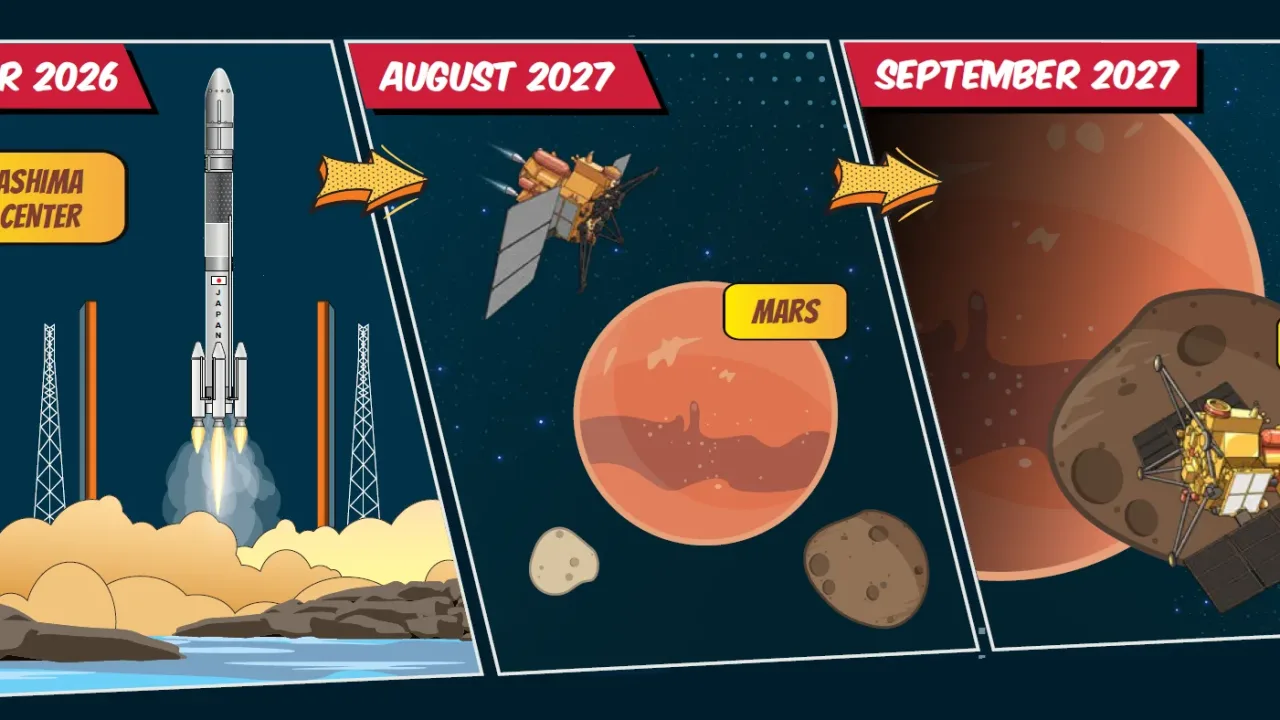
The Martian Moons eXploration mission, known as MMX, is scheduled to lift off aboard an H3 rocket from the Tanegashima Space Center in southwestern Japan at 4:41 a.m. local time on Tuesday, Oct. 20, which corresponds to 3:41 p.m. EDT on Monday, Oct. 19. The project is spearheaded by the Japan Aerospace Exploration Agency, or JAXA, in partnership with NASA, the European Space Agency, and French and German space authorities.
Journey to the Martian System
Development of the three-module spacecraft cost roughly 55.3 billion yen, or approximately $350 million, NHK reported. The spacecraft is projected to take about one year to travel to the Red Planet, entering orbit around Mars in August 2027 before moving into a closer orbit around Phobos about a month later.
The spacecraft carries 11 scientific instruments, including high-resolution mapping cameras, a laser altimeter, an infrared spectrograph, and a gamma ray and neutron detector contributed by NASA called MEGANE. The instruments will map Phobos in detail and also study the smaller outer moon, Deimos, from a distance.
In early 2029, the mothership is scheduled to drop a 25-kilogram rover named Idefix onto the surface of Phobos from an altitude of between 40 and 100 meters. Jointly built by JAXA, France’s CNES and Germany’s DLR, the microwave oven-sized rover will right itself and operate for roughly 100 days. It will examine surface soil and texture while transmitting data to help mission controllers select the safest landing site for the primary spacecraft.
Touching Down in Microgravity
Phobos has a tiny gravitational field with approximately one-2,000th of Earth’s gravity, posing significant navigational and mechanical challenges. The main spacecraft will attempt to touch down on the moon’s surface for roughly two and a half hours, potentially sampling at two separate spots, according to reports.
Controllers intend to gather at least 10 grams of moon dust and small rocks. The spacecraft is equipped with two different collection systems: JAXA’s C-sampler, designed to extract a core from a depth of at least two centimeters, and a pneumatic sampler developed by Honeybee Robotics for NASA that uses high-pressure bursts of nitrogen gas to blow loose particles into a retrieval chamber. NASA will curate about 15 percent of the returned sample at the Johnson Space Center in Houston.
Scientists hope the material will settle whether Phobos and Deimos are captured asteroids or the result of a colossal impact on ancient Mars that threw debris into orbit. Because meteorites frequently strike Mars, Phobos may also harbor soil blown directly off the Martian surface.
After completing its surface work, the return module will blast away from Phobos and start the journey home. The mission is scheduled to parachute its sample capsule into the Australian desert in 2031, or within the Japanese fiscal year concluding in March 2032, providing laboratory researchers around the world with their first close-up look at a Martian satellite.