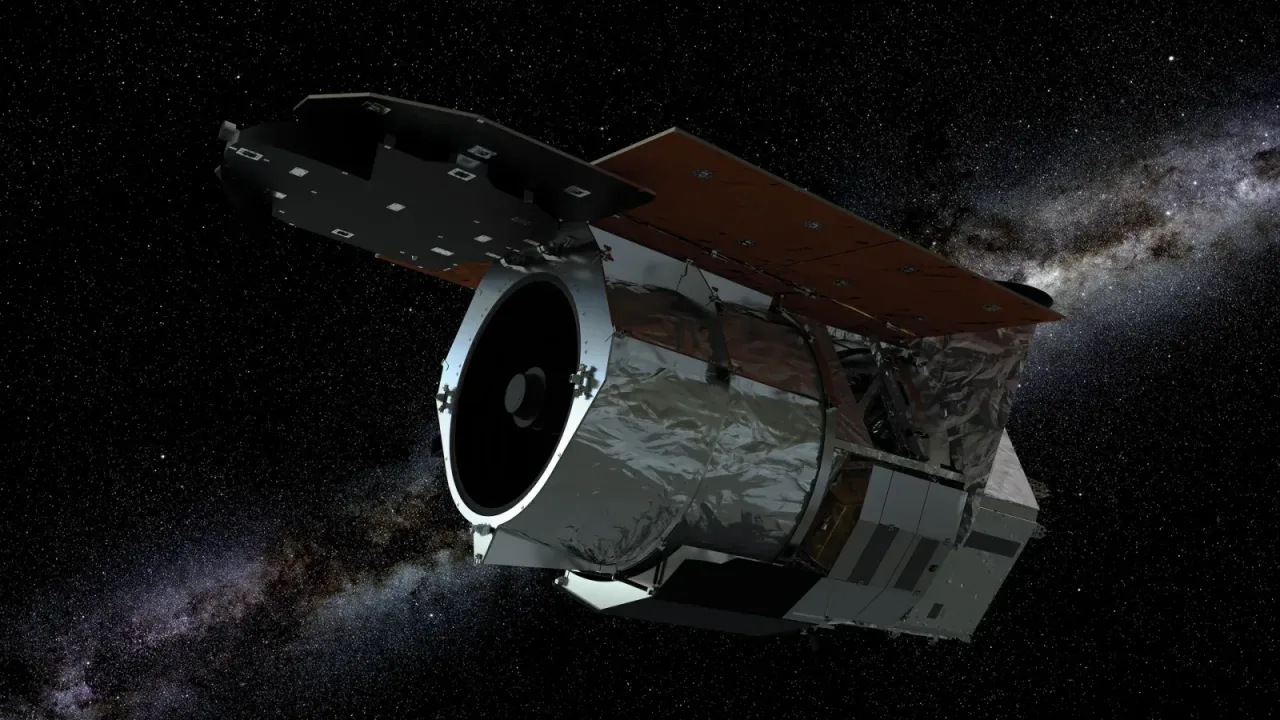
An international scientific team led by a University of Missouri astronomer is preparing to conduct an unprecedented survey of the distant cosmos following recent optical adjustments to NASA’s Nancy Grace Roman Space Telescope, researchers announced.
The initiative, known as the Roman eXtreme Deep Field, unites 130 researchers across 62 institutions, including the California Institute of Technology, Harvard University and Princeton University, Phys.org reported. NASA has allocated 386 hours of observation time on the newly launched observatory to execute the survey, which was outlined in a paper posted to the arXiv preprint server.
Sharpening a cosmic lens
The Nancy Grace Roman Space Telescope launched on Aug. 30 and is positioned to operate in an orbit approximately 930,000 miles from Earth. Earlier this week, NASA reported that engineers at Goddard Space Flight Center in Greenbelt, Maryland, completed a series of preparatory activities to verify the observatory’s optics and test its primary imaging device, the 300-megapixel Wide Field Instrument.
Aligning the telescope required microscopic precision. Alden Jurling, a senior optical engineer at NASA Goddard, explained that the team adjusted the observatory’s secondary mirror by roughly one-sixteenth the thickness of a human hair. Following those corrections, the Wide Field Instrument achieved an optical alignment error of 63 nanometers root mean square, surpassing NASA’s baseline requirement of 90 nanometers and operating nearly 30 percent better than models had anticipated, the agency reported.
The engineering checkout also included testing the instrument’s 18 detectors, an element wheel housing optical filters, internal calibration light-emitting diodes and thermal regulation systems, according to NASA systems engineers Dave Hickey and Maxime Rizzo.
Uncovering the cosmic dawn
With Roman’s Wide Field Instrument capable of capturing scenes in a single snapshot that would require hundreds of individual pointings from the Hubble or James Webb space observatories, scientists intend to map a much wider expanse of the ancient cosmos, Phys.org reported. Because light from remote objects takes billions of years to reach Earth, observing deep space allows researchers to study celestial structures as they existed during the universe’s first 100 million years.
The collaborative project plans to catalog thousands of early galaxies, measure how rapidly young systems produced stars and detect distant exploding stars called supernovae, which provide insight into the earliest stellar generations. The team will also examine how supermassive black holes formed and grew so quickly during the cosmos’s infancy.
The wide imaging area may also resolve questions surrounding compact, puzzling objects dubbed “little red dots,” which were initially identified by the James Webb Space Telescope. Haojing Yan, a professor of physics and astronomy at the University of Missouri and the project’s lead investigator, emphasized that broad deep-field surveys often deliver findings that researchers never anticipated.
Engineers at NASA plan to continue calibrating Roman’s second scientific package, the Coronagraph Instrument, and test its starlight-blocking technology in the coming weeks before the observatory transitions into routine scientific operations.