A European robotic spacecraft is closing in on a distant pair of space rocks to conduct a forensic investigation into humanity’s first planetary defense experiment, scientists announced.
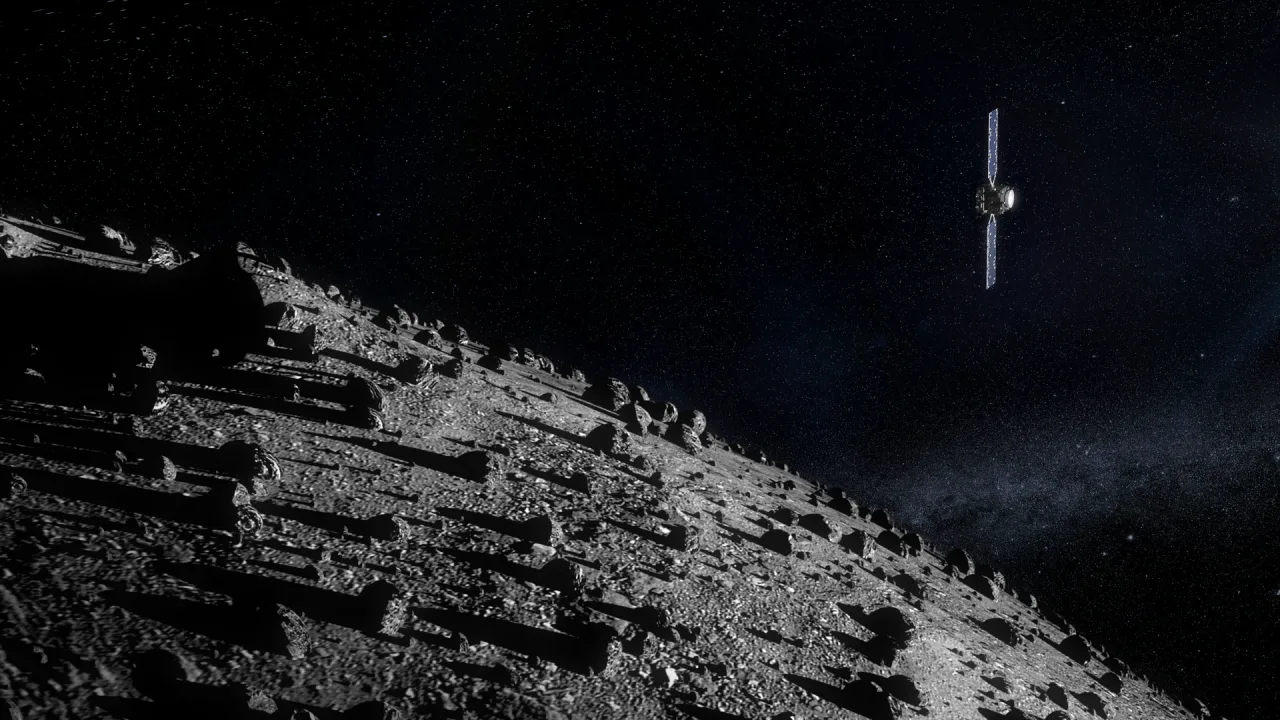
The European Space Agency’s Hera mission fired its thrusters on Oct. 15 in the first of three braking burns intended to match speed with the binary asteroid system of Didymos and its smaller moonlet, Dimorphos, according to reports from Gizmodo and Space. The maneuvers will allow the car-sized probe to pull within roughly 20 miles of the asteroids in early November to begin gathering detailed observations.
Investigating the crash site
Hera’s arrival marks the culmination of a journey that began with its launch on Oct. 7, 2024. Its destination is the cosmic collision site left behind when NASA intentionally steered its Double Asteroid Redirection Test spacecraft into Dimorphos on Sept. 26, 2022.
NASA’s 1,340-pound DART impactor slammed into the 558-foot-wide asteroid at hyper-velocity to test whether a deliberate kinetic strike could alter a hazardous celestial body’s path. Ground-based telescopes confirmed the strike succeeded, cutting the moonlet’s orbital period around the 2,625-foot Didymos from 11 hours and 55 minutes down to 11 hours and 23 minutes—a reduction of roughly 33 minutes.
However, scientists say ground measurements still leave a residual uncertainty of about 10 percent regarding the asteroid’s mass and interior structure, Gizmodo reported.
“Hera wants to be the detective, like Inspector Colombo, going back to the crash scene,” Patrick Michel, a planetary scientist at the French National Centre for Scientific Research and principal investigator for the mission, told Space.
Telescopic tracking revealed unexpected physical consequences after the collision. Observations showed the orbital period continued to shift slightly for as long as six months following the crash, leading astronomers to suspect Dimorphos may now be tumbling irregularly through space, according to reporting by cristinaiglesias.com.
“We know that there was a lot of material kicked up,” Angela Stickle, a planetary scientist at the Johns Hopkins University Applied Physics Laboratory, told Space. “We know that we probably left a pretty significant mark on Dimorphos.”
Probing a rubble pile from within
Rather than solid boulders, smaller asteroids such as Dimorphos are frequently loose “rubble piles” held together only by weak gravitational attraction, cristinaiglesias.com reported. Because of that fragile makeup, the DART impact may have significantly warped the rock’s overall shape and rearranged surface boulders rather than simply carving out a standard crater.
Earlier in October, Hera captured its first distant images of the duo from approximately 146,954 miles away. Following its close approach in November, the probe will navigate even closer in December to construct high-resolution three-dimensional models of both bodies.
The scientific survey will expand significantly in January 2027, when Hera is scheduled to deploy two shoebox-sized companion satellites:
- Milani, a CubeSat equipped with a hyperspectral imager to examine the mineral makeup of the asteroids and analyze dust thrown up by the collision.
- Juventas, a CubeSat carrying low-frequency radar to peer deep beneath the surface of Dimorphos, marking the first time researchers will directly sound the interior of an asteroid before intentionally landing on it.
The mission is scheduled to operate at the asteroids through at least September 2027, Space reported, providing data that engineers need to confirm whether kinetic impactors can serve as a dependable defense against future Earth-bound threats.