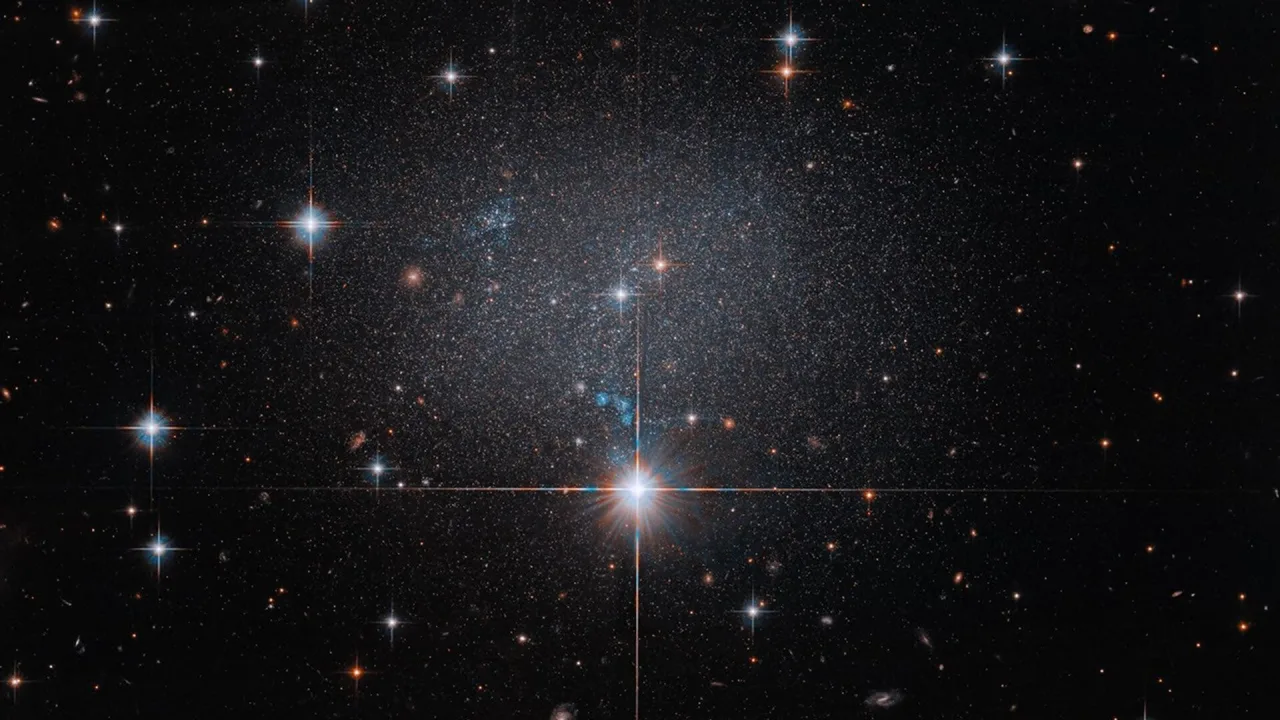
WASHINGTON — Small galaxies across our cosmic neighborhood are casting away almost all the oxygen forged inside their stars, according to new research based on observations from NASA’s Hubble Space Telescope.
In a study published in The Astrophysical Journal, an international team of astronomers examined 37 nearby dwarf galaxies, which hold anywhere from several thousand to hundreds of millions of stars within 22 million light-years of Earth. The researchers determined that these miniature star systems retained an average of only 11 percent of the oxygen their stars manufactured over billions of years, with the least efficient galaxies preserving a mere 4 percent and the most retaining about 25 percent.
Supernovas blow elements into space
Oxygen is the third most abundant element in the cosmos, trailing only hydrogen and helium. Because stars forge oxygen in predictable ways, scientists use it as an essential marker to track how chemical elements circulate through galaxies and out into deep space.
Yet dwarf galaxies possess far weaker gravitational pulls than giants such as the Milky Way. When massive stars reach the end of their lifespans and detonate in powerful supernovas, they generate fierce galactic winds. Those gusts appear powerful enough to propel vast reservoirs of freshly minted gas completely out of the galaxies.
“Oxygen is produced by stars, which are inside of galaxies. We know that the oxygen had to be inside of the galaxies at some point in the past, so the oxygen must have been ejected,” said study co-investigator Grace Telford, an assistant professor of physics and astronomy at the University of Utah.
The research is part of the Galaxies Losing Oxygen via Winds project, known as GLOW, supported by NASA and the National Science Foundation. To calculate the missing elements, the team analyzed archival optical images from Hubble, which possesses enough resolution to distinguish individual stars in nearby galaxies. By reviewing the brightness and colors of those stars, astronomers reconstructed the galaxies’ star-formation histories to calculate how much oxygen should exist.
The scientists compared those calculations with data gathered by NASA’s retired Spitzer Space Telescope and ground-based radio observatories, including the Very Large Array and the Australia Telescope Compact Array. They found that nearly all the remaining oxygen sat within galactic gas rather than locked inside stellar bodies.
Cosmic surroundings and future searches
The study also revealed that a galaxy’s environment might influence how much material it keeps. Dwarf systems situated within roughly 3 million light-years of a massive neighbor tended to retain higher levels of oxygen. In contrast, isolated dwarf galaxies located further away from large galactic neighbors invariably retained less than 15 percent.
Researchers suggested neighboring gas clouds may either push escaping elements back into the small galaxy or the dwarf system may sweep up gas expelled by adjacent systems, though scientists noted that this trend currently relies on data from a limited sample.
Where the expelled oxygen ultimately settles remains an active puzzle. Prior observations detected only modest amounts in the hot gas halos surrounding galaxies, indicating the rest likely escaped into the intergalactic medium.
Researchers plan to use the Nancy Grace Roman Space Telescope to discover even smaller, fainter galaxies across wide patches of sky before analyzing them with Hubble and the James Webb Space Telescope. Telford is also using Hubble to examine individual massive stars in GLOW target galaxies to clarify how they drive material into intergalactic space.