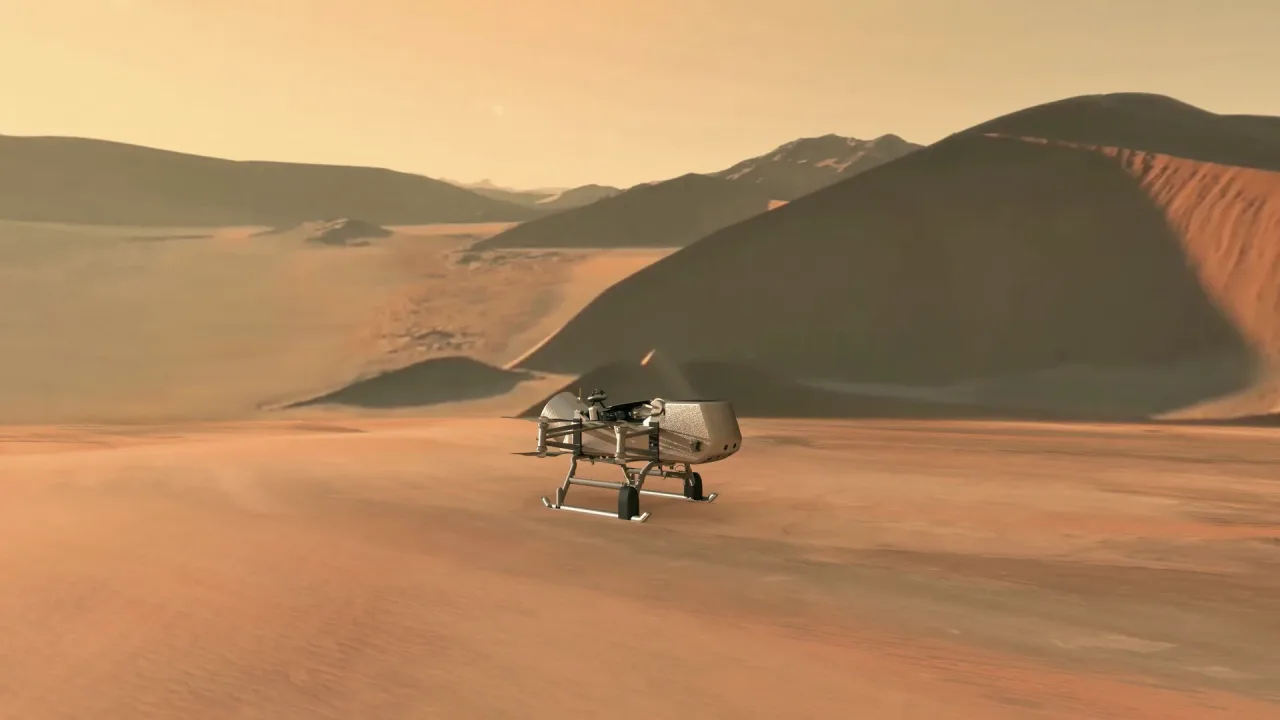
Members of the public can now claim a symbolic boarding pass for a journey across the solar system as NASA prepares its upcoming Dragonfly mission to Saturn’s largest moon, Titan.
The space agency opened a public registration process allowing individuals to submit their names to be etched onto a microchip that will ride aboard the nuclear-powered rotorcraft. NASA stated that participants must submit their names by Jan. 15, 2027, at 11:59 p.m. EST, FOX Weather reported.
A long journey across the solar system
Dragonfly is scheduled to launch from Earth in 2028, with The Daily Astorian reporting a target window of July 2028. The vehicle faces a journey of nearly one billion miles before arriving at Titan in 2034, with an anticipated arrival in December of that year, according to the outlet.
The craft itself is roughly the size of a sport utility vehicle, measuring approximately 12.5 feet long, 12.5 feet wide and 5.5 feet tall. Once it arrives, Dragonfly will become one of the rare flying vehicles deployed to explore another celestial body. NASA previously flew the Ingenuity mini-helicopter on Mars, which completed 72 flights between 2021 and 2024 before sustaining rotor blade damage.
Titan, the largest of Saturn’s moons, is already known for having dynamic weather, sweeping dunes, changing seasons, and liquid rivers and lakes composed of hydrocarbons, according to NASA. The agency previously touched down on the distant moon with the Huygens probe, which separated from the Cassini orbiter and collected surface data for several hours in January 2005.
Investigating the ingredients of life
Once deployed on Titan, Dragonfly is planned to conduct operations for roughly 3.3 Earth years. The drone will fly between distinct landing zones across miles of terrain, making a flight every one or two Titan days, known as a Tsol. Each Tsol lasts approximately 16 Earth days.
“Dragonfly isn’t a mission to detect life — it’s a mission to investigate the chemistry that came before biology here on Earth,” said Zibi Turtle, the mission’s principal investigator and a planetary scientist at the Johns Hopkins Applied Physics Laboratory, in remarks reported by FOX Weather.
Among its planned research stops is the 50-mile-wide Selk Crater, where scientists believe past impacts may have melted ice to form a primordial chemical mixture that is now frozen. Researchers hope the site provides clues regarding prebiotic chemistry, showing what conditions existed before life emerged on Earth, Space reported.
The craft will use an onboard suite of scientific instruments to evaluate surface samples, looking for chemical markers of prebiotic progression and indicators of water-based or hydrocarbon-based processes. While assembly and testing continue ahead of the planned 2028 launch, members of the public can secure a digital boarding pass and follow mission preparations as engineers finalize the spacecraft’s design.