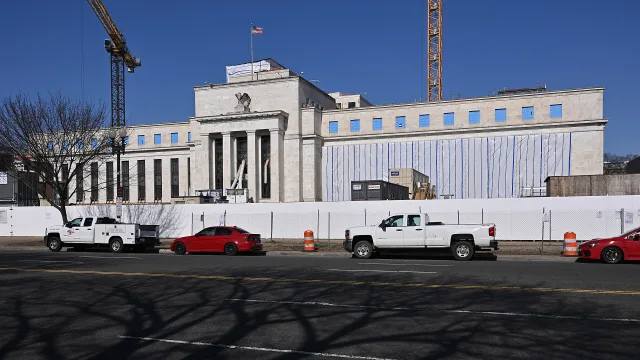
The Federal Reserve on Wednesday voted to leave its benchmark interest rate unchanged, concluding its final monetary policy gathering before the congressional midterm elections while confronting renewed inflationary pressures and political friction.
The central bank held the benchmark federal funds rate between 3.75 percent and 4 percent, ABC News reported. The pause followed a quarter-point increase in September, which marked the central bank’s first interest rate hike since 2023.
Division inside the central bank
Unlike the unanimous decision to increase rates in September, Wednesday’s action revealed growing internal disagreement. Federal Reserve Governor Lisa Cook and Cleveland Fed President Beth Hammack each voted against the pause, preferring an immediate interest rate increase, according to NBC News. For Cook, whom President Donald Trump has sought to dismiss from her post, the vote represented her first dissent on the board, NBC News reported.
In an official post-meeting statement, the rate-setting Federal Open Market Committee noted that “economic activity is expanding at a strong pace” but acknowledged that consumer costs remain problematic. “Inflation remains elevated. The accumulation of more information will help the Committee determine the policy stance appropriate to ensure a timely return of inflation to the Committee’s 2 percent goal,” the committee said, as quoted by NBC News.
Rising costs and political headwinds
Inflation figures have complicated the central bank’s trajectory. Consumer prices accelerated to a 3.7 percent annual rate in September, up from 3.4 percent in August, driven largely by climbing energy costs, including higher retail prices for gasoline, diesel and crude oil, according to Bureau of Labor Statistics figures reported by NBC News and ABC News. ABC News noted that the jump in fuel prices followed turmoil across the Middle East.
The economic climate has heightened voter scrutiny on the administration ahead of the midterms. An NBC News survey revealed that Trump’s approval rating stood at 27 percent for his stewardship of consumer costs and 29 percent regarding his handling of conflict with Iran. Roughly two-thirds of respondents described elevated fuel prices resulting from the conflict as a serious problem, and more than half reported altering their grocery shopping habits due to price pressures, NBC News reported.
Trump has consistently argued against higher borrowing costs, demanding on social media after the September rate increase: “LOWER THE INTEREST RATES FOR THE UNITED STATES OF AMERICA, AND FAST!” according to ABC News.
Labor market signals and what comes next
Policymakers are balancing sticky inflation against evidence of a cooling labor market. U.S. employers added 29,000 positions in September, down sharply from 162,000 jobs created in August, according to government data cited by ABC News. Analysts at Bank of America Global Research observed in a research note that the central bank faced a difficult dilemma between risking overtightening and appearing soft on inflation, ABC News reported.
Ahead of the midterm vote, analysts at Deutsche Bank Research suggested Fed officials may have welcomed avoiding headlines related to borrowing costs during an election cycle centered on affordability, according to ABC News.
The Fed will receive its next key reading on price pressures on Thursday with the release of the Personal Consumption Expenditures price index, which forecasters project will reach 3.7 percent, NBC News and CNBC reported. Investors widely anticipate that borrowing costs will rise again before the year ends, with market indicators tracked by CME Group’s FedWatch Tool pricing in roughly an 80 percent probability of a quarter-point rate hike at the December meeting, ABC News reported.