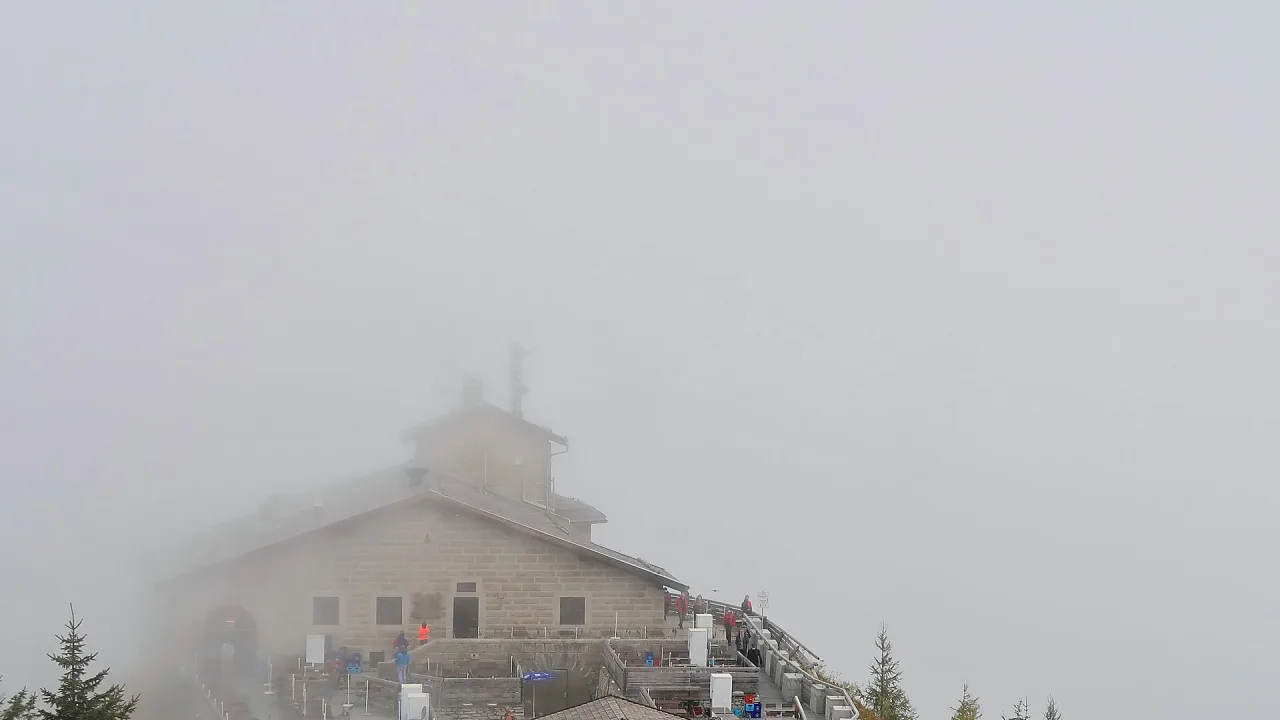
BERCHTESGADEN, Germany — German officials and historians are grappling with how to handle the charred remains of the Kehlsteinhaus, the mountaintop retreat built for Adolf Hitler, following a devastating fire late last month.
Emergency crews were called to the Alpine landmark, widely known as the Eagle’s Nest, on the evening of Oct. 23 after alarms sounded, according to local authorities. Despite the efforts of roughly 200 firefighters who struggled against heavy winds, rain and early snowfall, the historic structure was reduced to a shell. Because the complex was closed to the public at the time, no injuries were reported, but officials estimated property damage in the high single-digit millions of euros.
Police detained a 33-year-old German man on a motorcycle heading down the restricted access road shortly after responders arrived. Prosecutors said the suspect, who has regional ties, exhibited signs of mental illness and was transferred to a psychiatric hospital while investigators examine whether there was any political motive.
Preservation or Reproduction?
The destruction has triggered an intense national conversation regarding how modern Germany should manage its totalitarian past. Perched at an altitude of more than 6,000 feet near Berchtesgaden in southeastern Bavaria, the complex drew between 300,000 and 350,000 tourists each year before the blaze.
State leadership quickly signaled that the location would not be abandoned. Joachim Herrmann, the interior minister of Bavaria, said that officials would not simply permit the structure to sit as a ruin, adding that “it is important that we continue to do the work of remembrance.”
However, leading historians and memorial directors warn against recreating the Nazi-era architecture. Jens-Christian Wagner, director of the Buchenwald concentration camp memorial, cautioned in an interview with The Telegraph that historical relics serve as vital physical evidence. Wagner stated that reconstructing the building would produce “fake history” and argued the fire provides a chance to hold a competition to respectfully repurpose the mountain footprint.
Sven Keller, who directs the nearby Obersalzberg Documentation Center, likewise noted that an exact reconstruction is out of the question due to the severity of the wreckage. Keller advocated instead for integrating the preserved physical remnants into a broader educational display that addresses the site’s complete evolution, ranging from its construction in 1938 to postwar tourism and the recent fire.
Concerns Over Extremism
Completed in 1938 after more than a year of labor by thousands of workers, the Kehlsteinhaus was utilized by the Nazi regime to host foreign dignitaries. Following World War II, the property functioned as an Allied command post until the state of Bavaria assumed control in 1960, later operating it as a cafe and museum exhibition. Another prominent nearby Nazi structure, Hitler’s Berghof residence, had been blown up in 1952 and largely buried under brush to prevent far-right veneration.
Specialists in German history have voiced apprehension that a gleaming reconstruction could draw far-right sympathizers looking for symbols of dictatorial power. Mary Fulbrook, a professor of German history at University College London, told The Telegraph that restoring the complex risks reviving the visual impact of fascist architecture, though she noted a carefully contextualized ruin could serve memory culture.
For local operators, the sudden destruction brought an abrupt halt to decades of routine. Norbert Eder, who oversaw the site’s restaurant and gift shop for 37 years, told local media that most of his life’s work had vanished in the fire.
Bavarian Culture Minister Markus Blume announced that an expert panel spanning historical preservation, construction and Holocaust remembrance will guide the subsequent steps. In the meantime, officials plan to airlift scaffolding and security barriers to the mountaintop by helicopter as weather permits to protect the site from vandalism and extreme-right pilgrimages while a formal reconstruction strategy is devised.