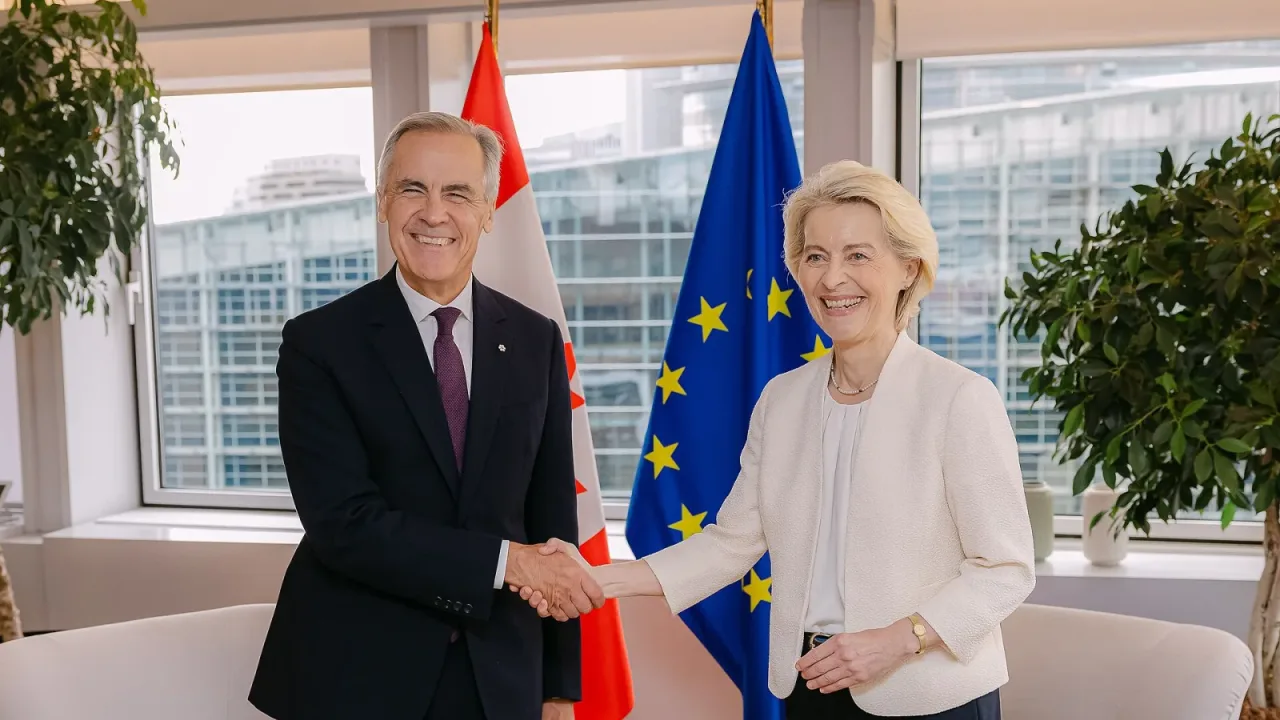
MONTREAL — Canadian Prime Minister Mark Carney welcomed top European Union officials to Montreal on Thursday for a two-day summit aimed at forging an unprecedented economic and security alliance, even after European governments pushed back against formal “associate membership” status for Canada.
European Commission President Ursula von der Leyen and European Council President António Costa joined Carney to begin negotiations on an “Alliance for the Future.” The initiative seeks to expand cooperation across trade, defense procurement, clean technology, critical minerals and educational exchanges as both transatlantic partners attempt to lessen their reliance on the United States, the Associated Press reported.
Dispute Over Associate Status
The Montreal meetings opened after EU member states moved to scale back von der Leyen’s surprise September proposal to designate Canada as an “associate member,” according to reporting by The Guardian and German broadcaster DW. Diplomats in Brussels expressed concern that the title lacked legal grounding in EU treaties, lacked prior consultation, and risked confusing arrangements discussed for prospective European members such as Ukraine.
German Chancellor Friedrich Merz, alongside officials from France and Italy, insisted on dropping the label from the final summit declaration, DW reported. Instead, a revised draft seen by The Guardian and DW commits both sides to define an “ever closer association” short of full membership ahead of their 2027 summit.
Carney sought to downplay the dispute over official language during remarks to reporters before the summit.
“It doesn’t matter about specific names or nomenclature,” Carney said. “What matters is the difference that it will make to lives of Canadians.”
Carney has previously rejected full EU membership, which would oblige Canada to adopt the European bloc’s internal regulations and budget obligations. Canadian officials confirmed that any enhanced partnership will require approval by Canada’s Parliament.
Economic Security and U.S. Tensions
The push toward Europe comes amid increasing strain between Ottawa and Washington under U.S. President Donald Trump. Last year, the U.S. accounted for 71.7 percent of Canadian merchandise exports, AP reported. Carney has set a goal to double Canadian exports to non-U.S. markets over the coming decade.
Trump previously criticized the associate membership proposal as “laughable” and warned that Washington could halt commerce or impose punitive tariffs on European goods if the United States views the pact as a “hostile act,” according to The Guardian and DW. When questioned Wednesday regarding possible U.S. retaliation, a senior Canadian official told reporters the bilateral talks were rooted in shared values rather than hostility toward Washington.
Economic analysts suggest the upside could be significant. TD Economics published a report noting that reduced trade friction in defense, energy, digital commerce and minerals could unlock tens of billions of dollars in new business between Canada and the bloc, The Guardian reported.
Expanding Defense and Energy Links
Beyond commerce, the summit agenda includes efforts to strengthen supply chains for critical minerals, assess the feasibility of shipping Canadian liquefied natural gas to Europe, and explore joint military purchases. Canada is already the only non-European country taking part in the EU’s 150-billion-euro ($167-billion) SAFE defense procurement initiative, AP noted.
Ottawa is also reviewing its military purchases, weighing whether to proceed with buying 72 American-built F-35 fighter jets or substitute Sweden’s Saab Gripen after committing to an initial batch of 16 F-35s. However, deeper industrial defense integration still faces hurdles in Europe, where France has lobbied for stricter rules favoring domestic manufacturers.
Negotiations launched in Montreal will unfold through ministerial sessions over the coming year, with European and Canadian officials aiming to establish a finalized framework for their partnership by 2027.