NASA has temporarily suspended scientific work for two of its major Mars missions while engineers troubleshoot separate technical issues affecting the Perseverance rover on the Martian surface and the Mars Odyssey spacecraft orbiting the planet, agency officials announced Thursday.
Radio Issues Sidelined Perseverance Rover
The Perseverance rover, which landed inside Mars’ Jezero Crater in February 2021, experienced a breakdown in its primary communication system on Oct. 30. During routine morning operations, the vehicle’s primary ultra-high frequency downlink radio failed to transmit an expected sequence of electronic pings, known as heartbeats, to the main computer. According to NASA, 25 consecutive missed heartbeats across roughly 100 seconds triggered automatic fault protection routines that shut down non-essential systems and placed the rover into a protective safe mode.
Although ground teams successfully brought Perseverance out of safe mode, diagnostic testing revealed that its backup radio was transmitting at roughly half of its normal power output, NASA Science reported. Project manager Steven Lee noted at NASA’s Jet Propulsion Laboratory that the onboard computer is designed to swap to the secondary system whenever the primary radio stops responding, but engineers decided to stop using both radios while investigating the root causes.
Perseverance remains stable and is currently communicating directly with flight controllers on Earth using its high-gain X-band antenna and NASA’s Deep Space Network dishes. Because this direct transmission route operates at a significantly lower data transfer rate than relaying data through orbiting satellites, mission managers paused scientific activities, including taking photos with the rover’s camera suite, to conserve bandwidth for diagnostic data. The pause explains why the rover’s public website has not published new raw images since Nov. 7. Ground teams express optimism that Perseverance could resume scientific exploration by the end of November.
The technical setback occurred shortly after Perseverance achieved a major milestone on Oct. 11, setting a new off-world driving record by covering more than 28 miles across the surface of Mars, surpassing the previous record set by NASA’s Opportunity rover.
Reaction Wheel Malfunction Threatens Odyssey Orbiter
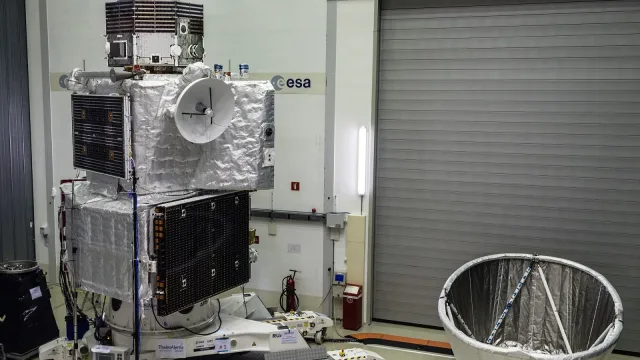
Meanwhile, the 2001 Mars Odyssey orbiter is confronting a critical mechanical issue that threatens to shorten its historic mission. On Nov. 4, the spacecraft entered safe mode after one of its four reaction wheels stopped spinning. Odyssey exited safe mode on Nov. 6, but its scientific instruments and data-relay systems remain offline while engineers at NASA JPL and Lockheed Martin conduct tests.
Reaction wheels adjust spacecraft orientation by spinning to generate rotational force, keeping solar arrays pointed toward the sun and scientific equipment pointed at target locations. Odyssey requires at least three functional reaction wheels to maintain its orientation without burning fuel. Because the spacecraft lost another reaction wheel in 2013, the loss of a second wheel leaves it dependent on hydrazine thrusters.
If engineers cannot recover the malfunctioning wheel, NASA estimates the orbiter has only enough hydrazine fuel remaining to maintain its position for one to two months, Space reported. During recent testing, controllers successfully commanded the faulty wheel to move, giving engineers hope that the component might be restored. NASA aims to conclude testing and potentially return Odyssey to science and data-relay operations during the final week of November.
Longstanding Mars Missions Face Critical Tests
Launched in April 2001, Odyssey is the longest-operating spacecraft at Mars, far exceeding its original two-and-a-half-year design lifespan. Over its 25 years in Martian orbit, Odyssey created foundational maps of surface composition, located shallow ice deposits, and served as a vital relay hub for landers and rovers, including Spirit, Opportunity, Phoenix, and Curiosity.
NASA noted that further updates will be provided as engineers complete diagnostic tests on both spacecraft before the end of November.