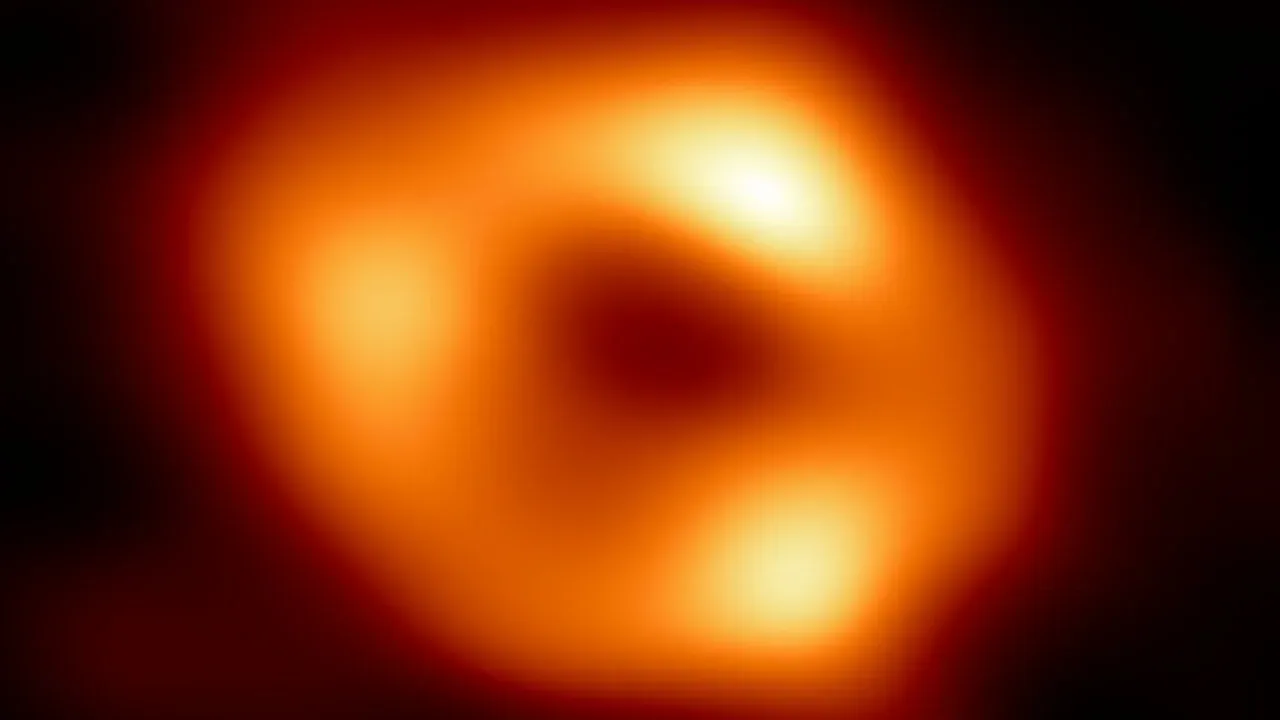
An independent research team in Australia has officially verified the historic first image of a supermassive black hole, validating both the initial 2019 observation and Albert Einstein’s general theory of relativity, according to a report by Space.com.
The original image, released to the public in 2019 by the Event Horizon Telescope collaboration, depicted M87*, a supermassive black hole possessing an estimated mass 6.5 billion times greater than the sun. Located 55 million light-years from Earth in the galaxy Messier 87, the object was initially captured using an Earth-sized network of synchronized radio observatories.
The new verification effort was led by Samuel Lai, a researcher at Australia’s Commonwealth Scientific and Industrial Research Organisation, or CSIRO. Writing in the journal Nature on Nov. 11, the research team detailed how it reprocessed the telescope data without feeding their computational models any preliminary information about what a black hole ought to look like.
A New AI Technique to Filter Data
Lai explained that photographing such a distant cosmic object presents extraordinary technical hurdles. “It is like standing in your backyard and trying to take a photo of a doughnut on the moon,” Lai said in a statement sent to Space.com.
To clear atmospheric distortion and potential biases introduced by linking observatories across the planet, Lai’s team designed an artificial intelligence machine-learning method called GenDIReCT. When applied to the initial dataset, the algorithm reconstructed a circular ring structure nearly identical in shape and dimensions to the historic 2019 visual, Space.com reported.
Lai emphasized that because their machine-learning algorithm had no prior knowledge of a black hole’s visual form, the result marks the first truly independent confirmation of the Event Horizon Telescope image. The work helps resolve long-running questions about how much atmospheric disturbance and data processing algorithms affected the final picture.
Confirming Einstein’s Theory
The validation further supports Einstein’s 1915 theory of general relativity, which proposed that mass warps the fundamental fabric of spacetime to create gravity. German physicist Karl Schwarzschild later calculated that an extreme concentration of mass would produce a point of infinite density surrounded by an event horizon—a boundary where gravitational pull is so strong that even light cannot escape.
General relativity also predicted that the region around an event horizon would feature a luminous ring of superheated plasma encircling a dark central shadow. The Australian team’s independent reconstruction confirms that the observed structure of M87* aligns remarkably well with those century-old mathematical predictions.
Laurent Loinard, director of the Event Horizon Telescope Collaboration, welcomed the independent study, noting to Space.com that recovering the ring structure across multiple years through an independent method bolsters confidence in humanity’s understanding of black holes.
Broader Applications on Earth
Beyond deep-space astronomy, CSIRO researchers noted that the machine-learning tools developed for the project could yield benefits closer to home. The GenDIReCT algorithm could eventually be adapted to refine medical imaging technologies and improve subterranean seismic mapping for earthquakes.