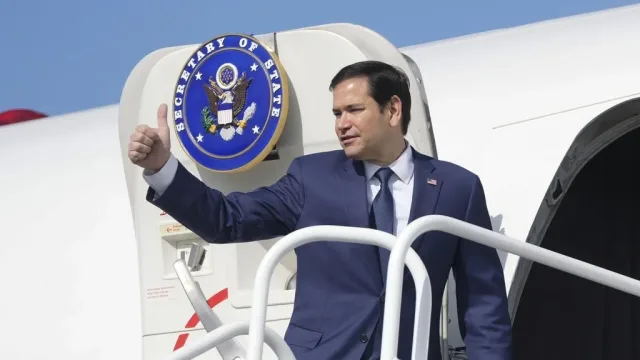
WASHINGTON — American intelligence officials have alerted Secretary of State Marco Rubio that Iran has accelerated attempts to harm U.S. personnel abroad, with lethal plots reaching advanced stages across the Middle East and other areas.
The unclassified memo, sent Friday by Director of National Intelligence Jay Clayton and first reported by Axios, stated that U.S. agencies have gathered intelligence showing Tehran has “substantially increased efforts to target U.S. personnel.” Clayton wrote that “the lethal plotting efforts by the Iranians against U.S. citizens have reached advanced stages in both the Middle East and certain other countries,” according to reports by Fox News and the BBC. Clayton added that officials were actively working to downgrade related intelligence so the State Department could circulate the information among its staff.
The one-page document did not publicly specify individual targets or name the nations outside the Middle East where activities were underway, the New York Post reported, nor did it declare whether an attack was imminent.
Diplomatic pullbacks in the Gulf
The warning coincided with swift moves by the State Department to reduce its diplomatic footprint in the region. Earlier this week, federal authorities ordered non-emergency government personnel and their family members to evacuate Saudi Arabia amid mounting missile strikes by Iran-backed Houthi forces in Yemen. On Friday, the department also enacted staffing reductions at embassies in Jordan, Lebanon, Qatar and the United Arab Emirates without mandating departures, according to the New York Post.
State Department spokesperson Tommy Pigott clarified that claims of a wider regional shutdown were inaccurate and that departure orders applied strictly to Saudi Arabia. A U.S. official told Fox News and the BBC that the twin threats of terror plots and Houthi strikes were directly guiding decisions regarding diplomatic posts placed on restricted operational status.
The security alerts follow weeks of intensifying regional conflict. Saudi authorities reported that Houthi strikes on airports have killed at least 21 people since early October, including an Oct. 10 missile attack at Riyadh’s international airport that killed 13 people and wounded more than 300, the BBC reported. The assaults followed a maritime embargo declared by the Houthis in July. Energy markets reacted swiftly to the turbulence, with Brent crude futures rising past $116 a barrel this week and U.S. West Texas Intermediate closing above $103, CNBC reported.
Uncertainty over military action
The heightened alert arrives as the Trump administration weighs whether to launch additional strikes against Iranian assets if negotiations fail. While the White House previously signaled that no military strikes would occur before the Nov. 3 midterm elections, contradictory statements emerged from diplomatic channels.
Tom Barrack, the U.S. ambassador to Turkey and special envoy for Syria, suggested during a podcast appearance that an American military strike could take place over the weekend, the New York Post reported. Asked about the claim in Florida on Friday, President Donald Trump distanced himself from the comment, remarking, “if that’s the case, I don’t know anything about it.”
Naval forces remain positioned in regional waters, including the aircraft carrier USS George Washington. While an Iranian diplomat in Islamabad told The Associated Press on Saturday that Tehran was open to renewing a June agreement to reopen the Strait of Hormuz in exchange for ending naval blockades, Iranian state media quickly disputed the remarks, leaving the path for diplomatic resolution unclear.