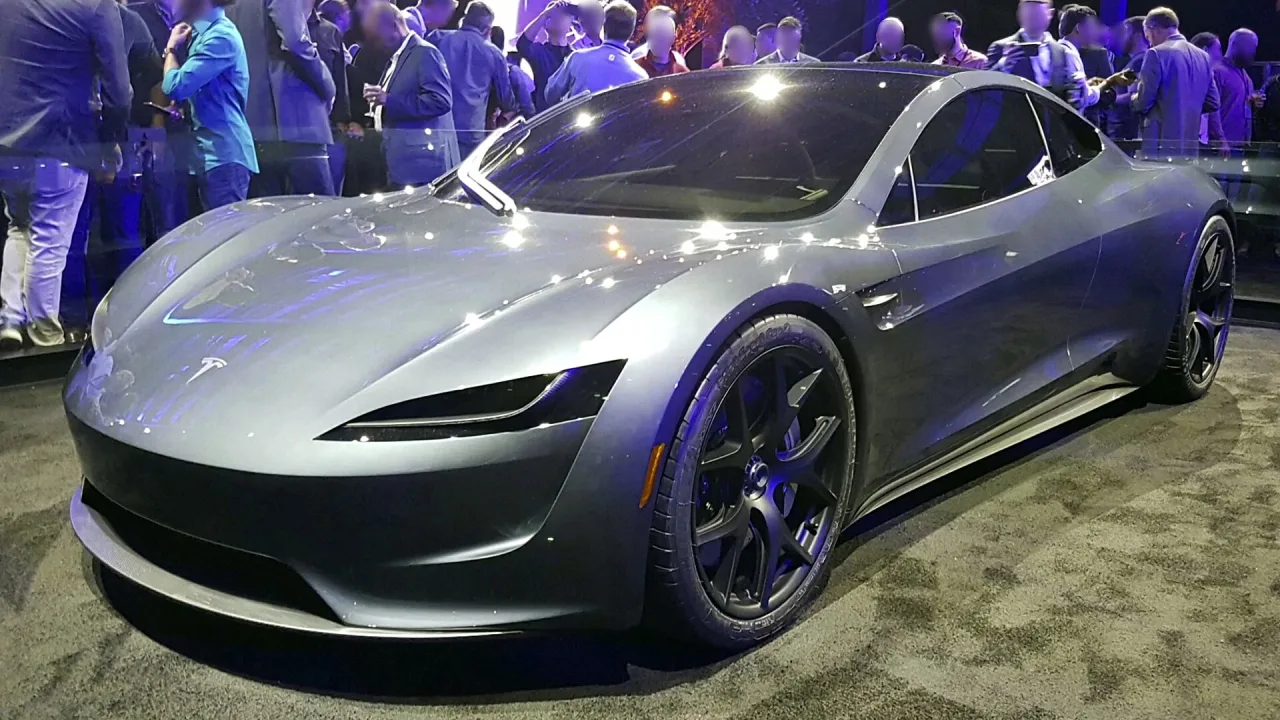
Tesla demonstrated a prototype of its next-generation Roadster on Thursday night in McGregor, Texas, utilizing rocket thruster technology to hop through the air and perform flips above other vehicles. Chief Executive Officer Elon Musk hosted the presentation at a SpaceX test facility, pitching the vehicle as a joint engineering milestone between the electric automaker and his aerospace venture.
During the livestreamed demonstration, an unmanned, remote-operated coupe drove up a curved track until it was inverted, using a fan-powered underbody suction system to stick to the surface. The vehicle then used cold-gas thrusters to launch roughly 21 feet into the air, executing a midair barrel roll over a row of Tesla models before touching down on its tires, according to news reports from the event.
SpaceX hardware and performance targets
Tesla Vice President of Vehicle Engineering Lars Moravy said during the presentation that the car’s suction fans generate up to two times the force of gravity to keep it bound to steep surfaces. The vehicle also carried 10 cold-gas thrusters powered by high-pressure air tanks—hardware commonly deployed to maneuver spacecraft—allowing it to reposition itself midair, CNET reported.
Tesla claimed the vehicle can accelerate from zero to 60 mph in 0.81 seconds when aided by thrusters, reach a top speed of 230 mph and deliver a battery range of at least 300 miles. Musk suggested during the presentation that the vehicle might eventually push toward half the speed of sound, though the figures have not been verified independently.
Musk stated that Tesla aims to begin production in 2028. Pricing details were not fully detailed, and reservation figures varied across reports. CBS News reported that reservations for a standard non-flying model required a $5,000 deposit, while the top-tier Rocket model would be available by invitation only. Meanwhile, CNET reported reservation fees starting at $50,000, and the New York Post reported that deposits reached up to $250,000 for a Thrust edition.
Regulatory hurdles and startup competition
Whether such a machine could legally operate outside closed tracks remains highly doubtful. Tesla’s website noted that the flying configuration is not authorized for use on public roads, CBS News reported. Furthermore, the Federal Aviation Administration informed CBS News that the prototype does not fall within its regulatory definition of an aircraft, while a senior U.S. Transportation Department official expressed skepticism regarding the mechanics of the vehicle’s flight.
Wall Street analyst Dan Ives noted that the vehicle is unlikely to generate meaningful sales volume. Instead, Ives wrote in a research note that the demo serves to elevate Tesla’s technology profile ahead of third-quarter corporate earnings scheduled for Oct. 21.
The showcase also prompted a reaction from Alef Aeronautics, a California startup building an electric vehicle designed for vertical takeoff. Alef published footage on Thursday showing its Model A flying over an earlier Tesla Roadster and a Cybertruck, calling it the company’s 1,000th logged flight. Alef Chief Executive Officer Jim Dukhovny welcomed Tesla to the emerging category, stating that competition from a major car manufacturer helps validate the market and build momentum for specialized government regulations.
While Alef secured a special airworthiness certificate from the FAA in 2023 and aims to begin limited customer testing by late 2026, Tesla faces a lengthy timeline to turn Thursday’s choreographed spectacle into a viable consumer product by 2028.