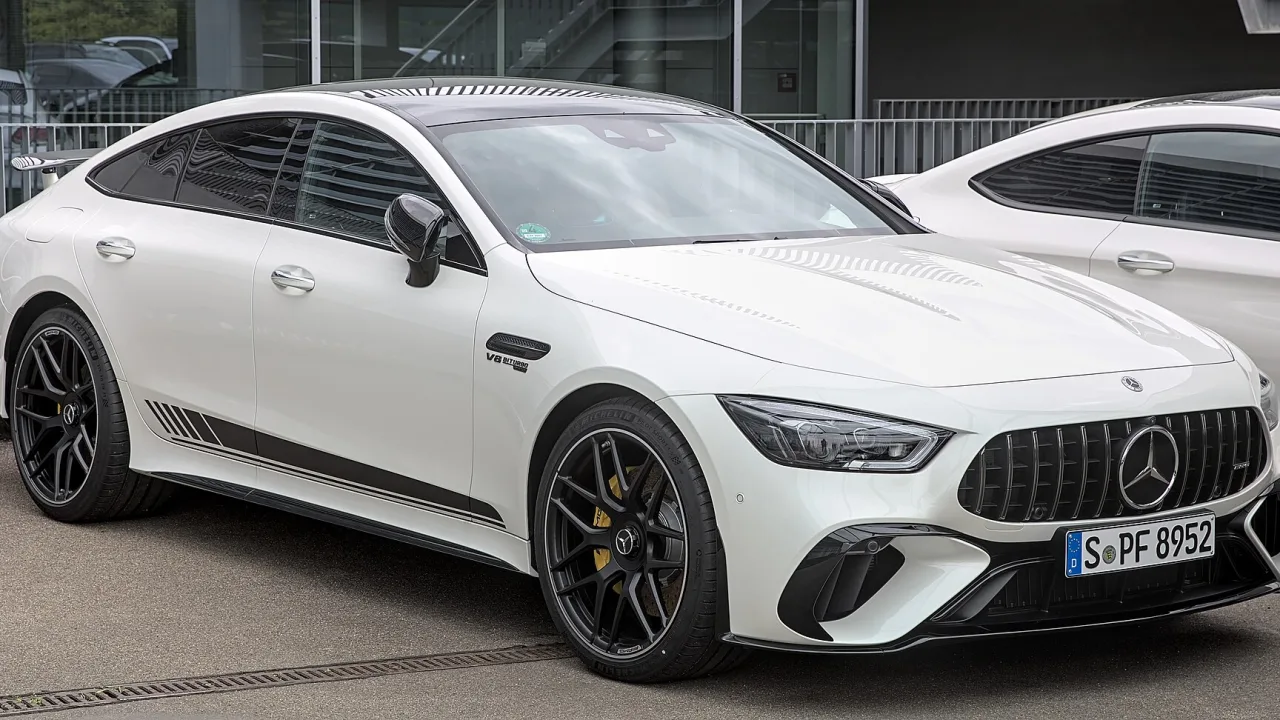
Mercedes-AMG revealed its first completely in-house developed full-size sport utility vehicle on Saturday, pulling the wraps off the all-electric GT SUV. The flagship electric hauler delivers up to 1,153 horsepower and supports direct-current fast-charging rates reaching 710 kilowatts, automotive outlets reported.
The vehicle serves as the second production model constructed on the automaker’s dedicated AMG.EA electric platform, following the GT four-door coupe introduced earlier this year. Mercedes expects the 2028-model-year vehicle to arrive at U.S. dealerships in the summer of 2027, according to reporting from Electrek and Motor1.
Three Trims and Axial-Flux Motors
Mercedes plans to offer three variants for the American market: the entry GT 53, the midrange GT 55 and the range-topping GT 63. The two upper configurations incorporate three axial-flux electric motors, mounting one unit on the front axle and two at the rear wheels. The pancake-shaped motor technology stems from Mercedes’ 2021 acquisition of British specialist YASA, providing higher power density than standard radial-flux motors, Electrek reported.
In the GT 63, the powertrain generates a peak 1,153 horsepower and 1,475 pound-feet of torque, alongside a continuous output of 711 horsepower. Published performance figures place the flagship model’s zero-to-60-mph sprint time between 2.4 and 2.6 seconds, with top speed capped at 168 mph. The intermediate GT 55 generates 805 peak horsepower, while the dual-motor GT 53 produces 536 horsepower through a two-speed rear transmission, according to Motor1 and InsideEVs.
To rein in the GT 63’s 5,942-pound curb weight on twisting pavement, AMG developed an active suspension system dubbed Active Ride Control+. The setup replaces traditional anti-roll bars with hydraulic actuators and adjustable air springs designed to manage pitch under braking and roll during aggressive turns, The Verge reported. Standard rear-axle steering provides up to six degrees of articulation to boost agility.
Battery Chemistry and Charging Milestones
Both the GT 55 and GT 63 house an 800-volt battery pack with 128 kilowatt-hours of usable capacity. The pack relies on cylindrical cells featuring nickel-cobalt-manganese-aluminum cathodes and silicon-infused anodes. To preserve thermal stability during track runs and rapid charging, electrically nonconductive cooling oil circulates directly around every individual cell, according to The Verge.
Under optimal conditions, the 128-kWh models can draw power at up to 710 kilowatts, which Mercedes claims can raise the battery charge from 10 percent to 80 percent in 12 minutes. The manufacturer estimates that 10 minutes plugged into a compatible charger can add roughly 280 miles of driving range under European WLTP testing protocols. The base GT 53 carries a 106-kWh battery that charges at up to 600 kilowatts.
Despite those paper capabilities, American drivers will face real-world infrastructure constraints, Electrek noted. Most public high-power stations rolling out across the United States currently max out at 400 kilowatts, well below the SUV’s operational ceiling.
Cabin Tech and Synthetic Acoustics
Inside, the dashboard centers on a 14-inch touchscreen powered by the MB.OS platform, paired with a 10.2-inch instrument display and an optional 14-inch screen for the front passenger. To help maintain driver engagement, AMG installed an acoustic and haptic system called AMGFORCE Sport+. The software routes recorded engine notes from historic AMG eight-cylinder and six-cylinder engines through the cabin, accompanied by artificial shift points controlled via steering wheel paddles and coordinated seat pulses.
Official pricing and U.S. Environmental Protection Agency range ratings have not yet been released. Mercedes indicated that window-sticker figures and domestic certification numbers will be finalized closer to the SUV’s showroom launch next year.