Scientists surveying forests in southwestern China have identified a massive, previously unknown fungus that grows up to 20 inches tall and weighs nearly five pounds, according to findings published in Frontiers in Fungal Biology.
The organism, named Dianjunus rex and nicknamed “D-rex,” sets a new size record for sac fungi and forms an entirely new taxonomic family. Genetic tracing indicates the lineage originated roughly 65 million years ago, shortly after the mass extinction event that wiped out non-avian dinosaurs, researchers said.
An unexpected giant on the forest floor
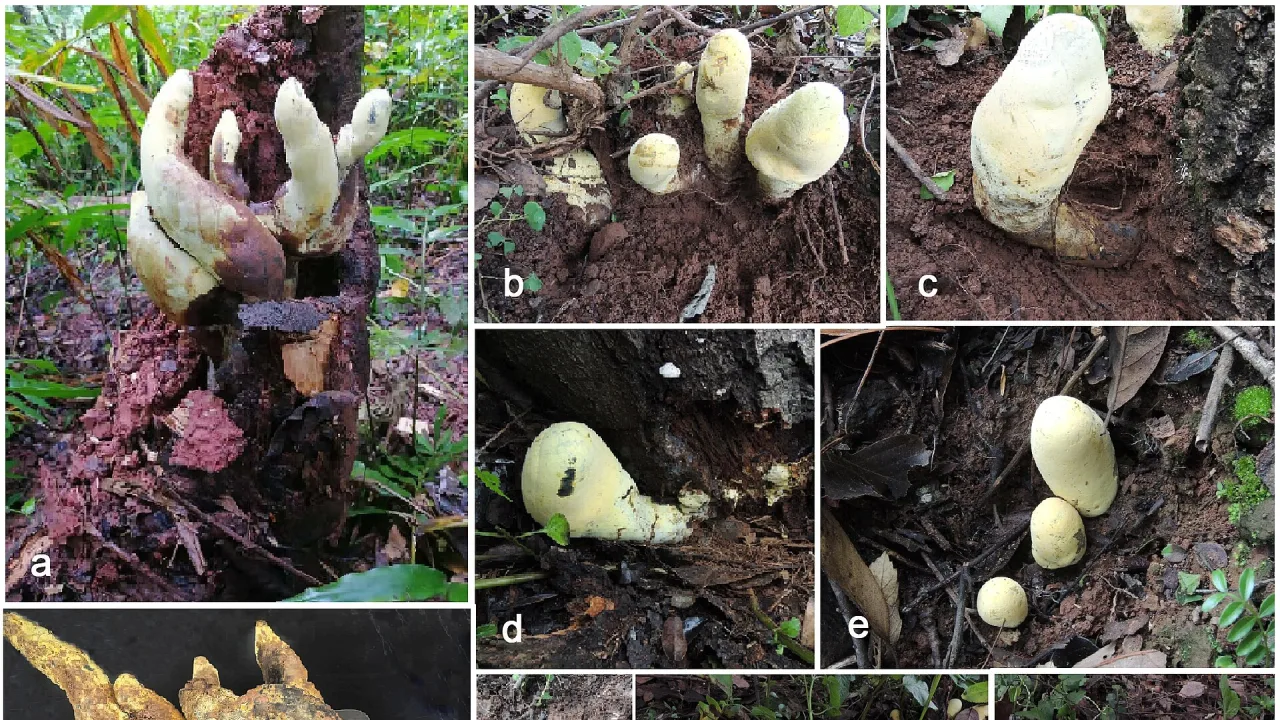
Specimens of the fungus were gathered during field surveys in Yunnan province across both tropical rainforests and temperate mountain woods, Sci.News reported. Researchers from the Kunming Institute of Botany were first alerted to the organism in 2024 when local farmers discovered the strange growths and sent photographs asking whether they were edible, according to Science News.
Field inspections revealed pale, fleshy structures emerging from the soil and attached to the root systems of Chinese cork oak trees. Rather than forming typical mushroom caps, Dianjunus rex produces finger-like or spatula-shaped reproductive structures called stromata that release microscopic spores. The largest specimen documented measured 50 centimeters in height and weighed 2.2 kilograms, or close to five pounds.
Those measurements make it the largest known fruiting body within the phylum Ascomycota, a massive fungal group encompassing more than 64,000 species that includes molds, truffles and morels, according to ScienceDaily. Before this find, the tallest known fruiting bodies in the group reached only about eight to 12 inches.
Laboratory analysis revealed that the species was sufficiently distinct from known fungi to establish both a new genus and a new family, Dianjunaceae, within the order Xylariales, ScienceDaily reported. Its closest living relative is Graphostroma platystoma, a wood-dwelling fungus found across the Northern Hemisphere.
Roots in a prehistoric catastrophe
Researchers used molecular clock dating methods to analyze the fungus’s DNA alongside hundreds of other species to determine when its evolutionary branch formed. The genetic data indicated the family emerged roughly 65 million years ago, about one million years after the Cretaceous-Paleogene extinction.
Scientists believe the timing is not a coincidence. Following the catastrophic asteroid impact that ended the age of dinosaurs, global ecosystems collapsed, leaving behind enormous quantities of dead and rotting vegetation. For fungi specialized in breaking down dead wood, the environmental upheaval likely provided a massive surge of food and new niches to colonize.
“During the dark, cold, postimpact years after the mass extinction, fungi that decompose dead organic matter could keep functioning better than light-dependent photosynthesizers,” said Indunil Senanayake, a mycologist at the Kunming Institute of Botany, in comments to Science News.
An evolutionary puzzle
Researchers are still investigating why the species evolved such towering reproductive bodies. Generating such bulk requires substantial biological resources, an investment that would only persist if it offered a clear survival advantage.
Senanayake suggested that towering above leaf litter and dense ground cover allows the fungus to expose its spores to higher air currents, dramatically improving wind dispersal across thick forest canopies, ScienceDaily reported.
Mycologists suspect additional relatives may still be hidden. Outside researchers noted that scanning environmental DNA databases for shed genetic traces could eventually help identify related species without needing to find rare physical samples first, Science News reported. Further surveys in Yunnan province may reveal how widely the ancient fungal family has spread across the region.