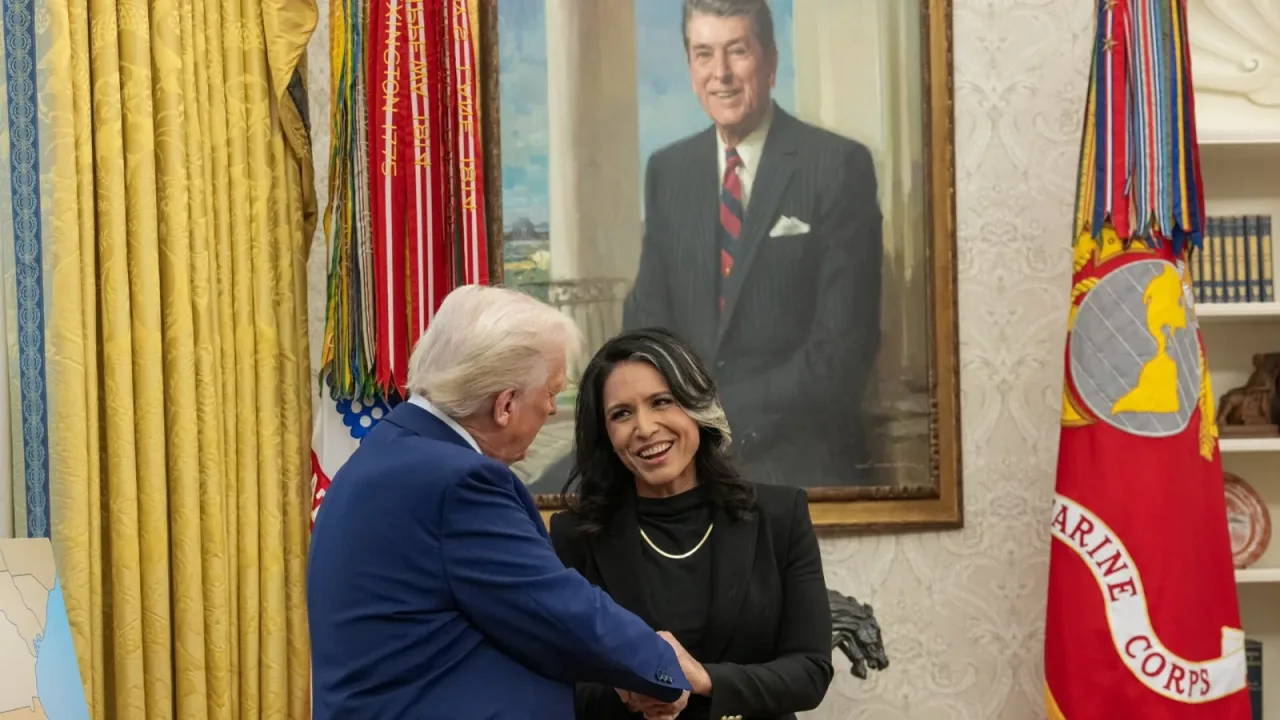
President Donald Trump and Vice President JD Vance unveiled a $25 million federal initiative aimed at paying cash bounties to people who report suspected government fraud, launching the effort by presenting an initial reward in the Oval Office, CBS News reported.
The effort, known as the Whistleblower Incentive Program, or WHIP, is backed by Treasury Department funding and will be overseen by the Department of Justice. Members of the public are invited to submit reports through Fraud.gov. Tipsters whose disclosures help investigators secure criminal charges or a conviction could receive awards ranging from $10,000 to $30,000, according to federal officials.
First reward presented in Oval Office
During the launch, Trump handed a $10,000 check to Nick Shirley, a conservative YouTuber who gained attention for videos alleging widespread fraud in Minnesota, CBS News reported. Trump remarked that the cash incentives would “keep a lot of people honest.”
Shirley published a 42-minute video in December 2025 claiming that nearly a dozen Minnesota day care facilities collected public subsidies without delivering child care services. Following the release of the footage, state regulators and Homeland Security agents visited several locations. A CBS News examination of state records revealed that all but two of the facilities held active operating licenses and had been inspected in the preceding six months, showing safety violations but no documented evidence of fraud as of Dec. 30, 2025. State records indicated that one facility, Quality Learning Center in Minneapolis, shut down in January after receiving $1.9 million through Minnesota’s Child Care Assistance Program during fiscal year 2025. Additionally, a woman who appeared in one of Shirley’s videos later pleaded guilty to charges of wire fraud and conspiracy to defraud the United States.
Debate over payouts and oversight
The program quickly faced questions concerning reward structures and how it compares to existing federal protections. Under the False Claims Act, whistleblowers can receive significantly larger shares of recovered money. When asked why the new initiative offered comparatively smaller sums, Trump proposed giving tipsters a 1 percent commission on recovered funds, telling reporters, “At 1 percent, people will make millions and millions of dollars.”
Vance defended the framework, stating that WHIP captures types of fraud falling outside the scope of the False Claims Act. Questions also arose regarding who decides who gets paid. Trump suggested he could personally intervene to settle disputes over payouts, though the Justice Department stated that reward distribution remains entirely at the agency’s discretion, according to Yahoo.
Public reaction and White House response
The debut of Fraud.gov prompted swift pushback and satire on social media platforms, where critics posted calls for authorities to examine Trump and his family’s finances, Yahoo reported. Online commenters cited past reports regarding Trump family business ventures, including a June Reuters analysis calculating that the family generated roughly $2.3 billion from cryptocurrency efforts, alongside an Associated Press review of international business holdings.
The White House forcefully rejected the criticism. “Neither the President nor any member of his family are defrauding the U.S. taxpayer,” White House spokeswoman Lauren Bis said in a statement, emphasizing that Trump donates his presidential salary to charity.
It remains to be seen how the Justice Department will manage the influx of public submissions at Fraud.gov and whether administrative rules will formally incorporate the 1 percent commission proposed by Trump.