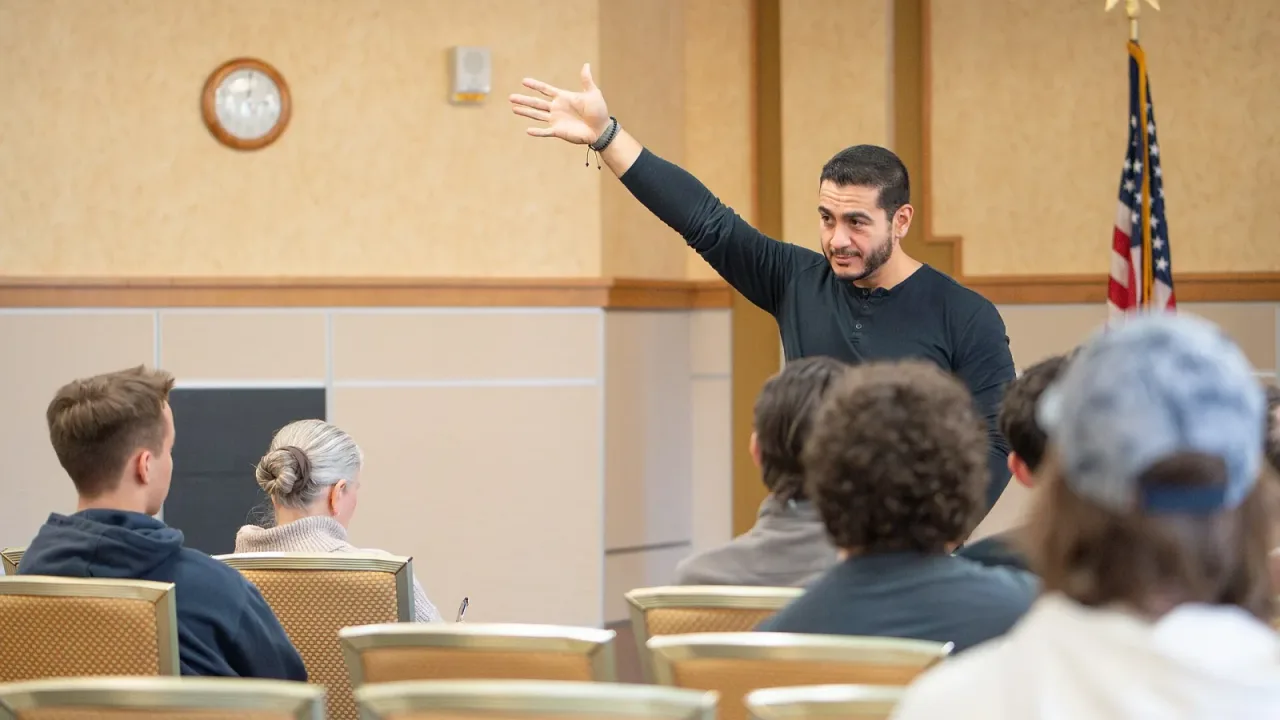
DETROIT — Michigan Democratic Senate candidate Abdul El-Sayed engaged in a tense on-air confrontation with Fox News anchor Bret Baier on Friday, repeatedly pushing back against questions concerning a 2012 open letter addressed to Egypt’s former president.
During a broadcast of “Special Report” from Detroit, Baier sought to question El-Sayed about an open letter reported by the Washington Free Beacon that El-Sayed and roughly 30 others signed in 2012. The document addressed Mohamed Morsi, a Muslim Brotherhood figure who served as Egypt’s president at the time, and urged overhauls of the country’s police force and media outlets.
El-Sayed, 41, interrupted Baier before the anchor could finish framing the query, arguing that the topic was being weaponized to question his patriotism.
“You are asking this question to raise the question about whether or not I have dual loyalty,” El-Sayed said during the broadcast.
When Baier replied that he was posing specific questions raised by the Republican campaign, El-Sayed told him, “Don’t be Rogers’ campaign. Be a journalist.” El-Sayed reiterated his commitment to the U.S. Constitution, emphasizing that he has never belonged to the Muslim Brotherhood, never would join, and intends to uphold the oath of office sworn by every U.S. senator.
Rival campaigns trade accusations
The Democratic nominee, a physician and former public health official, is running in a tightly contested election against former Republican Rep. Mike Rogers, 63, to succeed retiring Democratic Sen. Gary Peters. Recent public surveys showed El-Sayed maintaining a narrow lead of one or two percentage points over Rogers.
Appearing on the same program in a separate interview, Rogers doubled down on accusations that his opponent has embraced the ideology of the Muslim Brotherhood, pointing to the 2012 document. The organization is classified as a terrorist group by Egypt, the United Arab Emirates and Saudi Arabia, though not by the U.S. government.
Rogers argued to Baier that El-Sayed had avoided addressing the substance of the letter and claimed the Democrat had yet to sufficiently disavow the group. Rogers insisted the criticism was not tied to El-Sayed’s faith, saying, “It is not how he prays; it’s how he thinks.”
El-Sayed had previously explicitly disavowed the Muslim Brotherhood during an Oct. 17 town hall in Caro, Michigan, when asked by Thomas Teepell, a former Republican congressional aide, Fox News reported. News organizations reviewing the claims have found no evidence linking El-Sayed to the group.
Family history and campaign policy debates
GOP attacks against El-Sayed have also centered on past online posts written by his estranged half-sister, who described their mother’s activism with the Muslim Brotherhood during the 1970s. El-Sayed has repeatedly stated that he was raised by his father and stepmother after his parents separated when he was three years old, noting he has no connection to those past activities.
Beyond foreign policy and extremism claims, the candidates outlined sharp disagreements on domestic matters Friday, Fox News reported:
- On healthcare, El-Sayed expressed support for guaranteed public health coverage while permitting residents to retain private insurance, while Rogers contended Medicare-for-all proposals would terminate private plans and raise taxes.
- Regarding overseas conflicts, El-Sayed called for a war powers resolution to stop U.S. military strikes in Iran, blaming the war for fuel and food inflation. Rogers supported the initial military objectives but stated he urged President Donald Trump to conclude the operation.
- On trade, Rogers highlighted General Motors truck production in Michigan but noted he opposes the administration’s tariff strategy regarding Canada.
Both campaigns plan high-profile weekend appearances in Michigan featuring Trump and former President Barack Obama as voting nears.