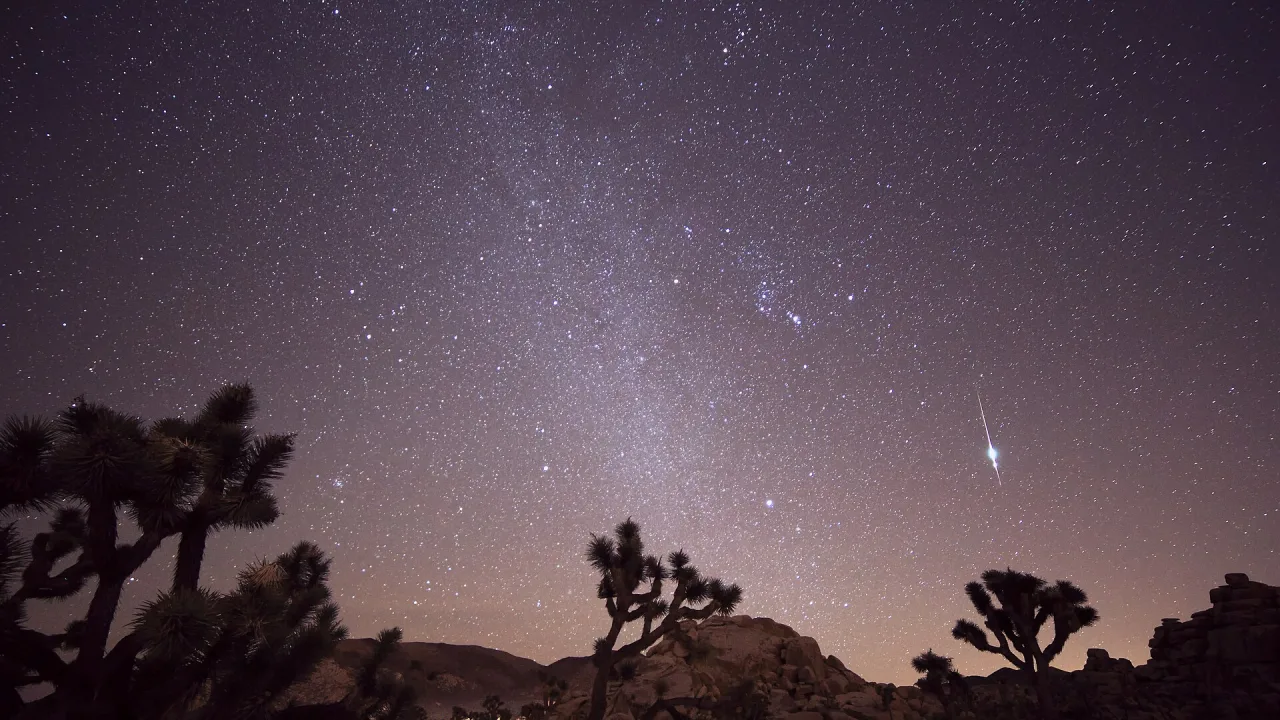
Stargazers across the globe have a chance to spot unusually bright meteors over the coming weeks as the twin Taurid showers enter their most active window, Space reported. Known informally among skywatchers as the “Halloween fireballs,” the overlapping displays are famous for generating vivid, leisurely streaks of light rather than high-volume bursts.
The Taurids comprise two distinct streams: the Southern Taurids and the Northern Taurids. Both radiate from the constellation Taurus near the Pleiades star cluster, according to Space. Because Taurus sits close to the ecliptic, the celestial path traced by the sun, the meteors can be viewed from both the Northern and Southern hemispheres.
Peak timing and viewing conditions
The Southern Taurids began on Sept. 20 and will remain active through Nov. 20, according to the American Meteor Society. While an initial component reaches its peak around Oct. 14, a separate stream linked specifically to fireballs peaks overnight on Nov. 4 to Nov. 5. Observers will benefit from favorable conditions that night, as the moon will appear as a faint 17 percent waning crescent rising only two hours before daybreak, Space reported.
Meanwhile, the Northern Taurids kick off Oct. 20 and continue until Dec. 10, peaking overnight on Nov. 11 to Nov. 12, according to the American Meteor Society. Stargazers should see even darker skies during that window, with the moon appearing as a slender five percent waxing crescent that causes virtually no glare.
Unlike major showers such as the August Perseids, the Taurids offer a modest frequency. Observers can generally expect about five meteors per hour under clear conditions from each shower, or around 10 per hour when both streams overlap in late October and early November. However, their speed sets them apart. Southern Taurid meteors hit Earth’s atmosphere at roughly 17 miles per second, while Northern Taurids enter at approximately 18 miles per second. That relatively low velocity creates long, conspicuous trails that are easier to track across the darkness.
Comet origins and fireball expectations
Both streams trace their origins to Comet 2P/Encke, a three-mile-wide icy body that completes an orbit around the sun every 3.25 years, according to NASA. That marks the shortest orbital period of any known comet. Scientists suspect the Taurids belong to a massive cloud of ancient cosmic debris created when a much larger parent object shattered thousands of years ago, Space reported.
Fireballs occur when larger fragments of that space debris burn up in the upper atmosphere. Enhanced fireball swarms occurred in 2008, 2015 and 2022, according to EarthSky. Although astronomers do not forecast another major debris swarm until 2032, observers can still expect occasional brilliant streaks this autumn.
The Taurids arrive alongside other autumn celestial events, including the Orionid meteor shower, which peaks Oct. 21, Scientific American reported. Astronomers advise skywatchers seeking Taurid fireballs to skip binoculars or telescopes, find an open area far from city lights, and give their eyes roughly 20 to 30 minutes to adjust to the dark.