Astronomers say they have, for the first time, traced radio waves directly to a planet orbiting another star, a result that offers a rare measurement of a distant world’s magnetic field.
The repeating bursts come from Beta Pictoris b, a giant gas planet roughly 63 light-years from Earth, according to a three-member team led by Kevin Ortiz Ceballos, a doctoral researcher at Harvard & Smithsonian’s Center for Astrophysics in Cambridge, Massachusetts. The team, which includes a researcher at the University of Oregon, posted its paper to the preprint server arXiv on Sept. 15. The work has not yet been peer reviewed.
The signal is not a message from aliens. The researchers say it comes from auroras, similar to Earth’s northern lights, produced as charged particles spiral through the planet’s intense magnetic field and give off radio energy.
Separating planet from star
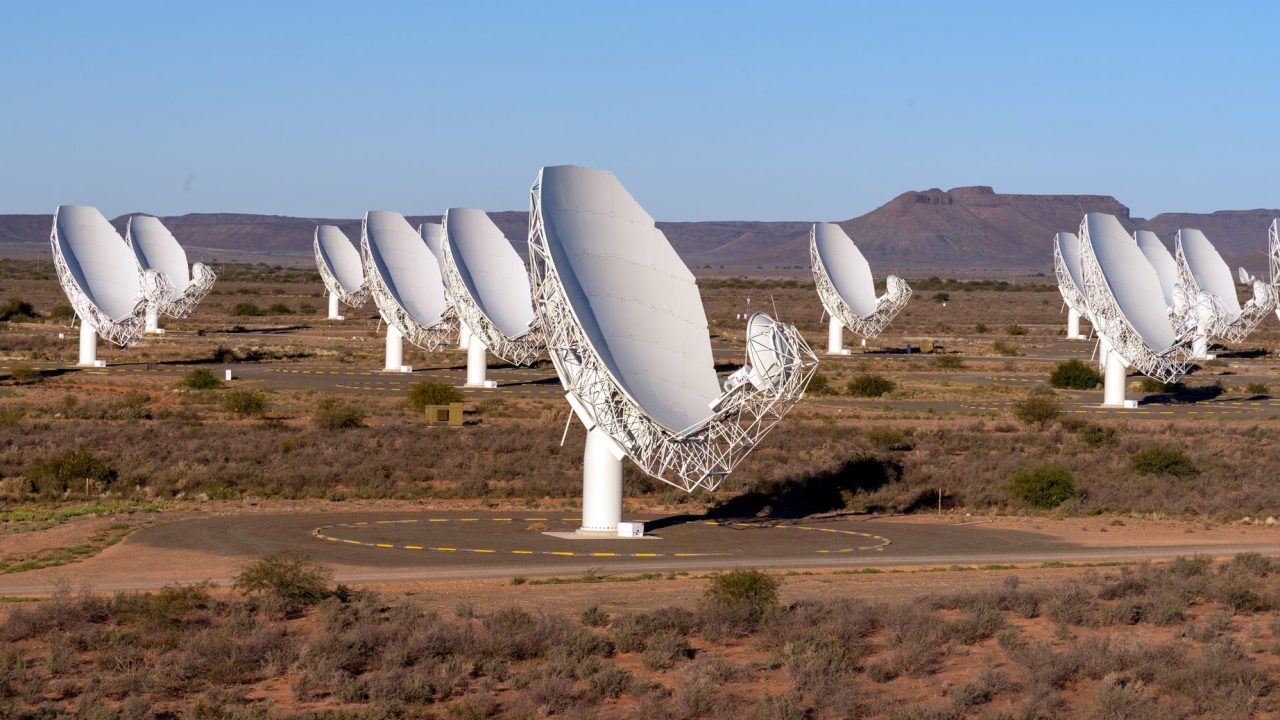
The team used MeerKAT, an array of 64 radio dishes in South Africa, to observe the Beta Pictoris system on four occasions in 2025 and 2026, according to ScienceAlert. The array picked up brief, recurring bursts that were strongly circularly polarized, a hallmark of auroral emission, across frequencies from 0.85 to 3.5 gigahertz.
Earlier studies had found hints of radio emission from exoplanets, but none could rule out the host star as the source. By using distant quasars as fixed reference points, the researchers showed that the bursts came from the planet rather than its star, ScienceAlert reported.
“What is unique for this study is that they localise the emission to the planet itself, separate from the star,” Joseph Callingham, an associate professor at the University of Amsterdam’s Anton Pannekoek Institute for Astronomy who was not involved in the research, wrote in an email to CNN.
Beta Pictoris b was discovered in 2008 by direct imaging. Estimates cited by CNN and ScienceAlert put its mass at roughly 10 to 12 times that of Jupiter, and it spins once every eight to nine hours. Its star is about 1.75 times as massive as the sun, and the system is about 23 million years old, compared with roughly 4.5 billion years for our solar system, CNN reported. Two other planets are known to orbit the same star.
An unusually strong field
The highest frequencies in the signal imply a magnetic field of at least 1,250 gauss at the planet, the researchers wrote, calling it the first direct measurement of an exoplanet’s magnetic field strength. Earth’s field at the surface is about half a gauss. Edo Berger, a Harvard astronomy professor and co-author of the paper, told CNN the planet’s field is at least 200 times stronger than Jupiter’s.
Berger said the strength was a surprise because astronomers had assumed exoplanet magnetic fields would look roughly like Jupiter’s, which would produce radio emission at lower frequencies. The authors wrote that the result fits predictions for a young, massive giant planet, and ScienceAlert reported that the planet’s rapid spin may help power the emission.
Magnetic fields help determine how planets hold on to their atmospheres and how they interact with the wind of charged particles flowing from their stars, the authors wrote. Earth’s own field, for example, keeps the solar wind from stripping away its atmosphere.
Jonathan Nichols, a professor of planetary auroras at England’s University of Leicester who was not involved in the study, told CNN that the discovery would be an exciting step if it holds up under peer review. “Auroral radio emissions are important because they allow us to understand how an object interacts with its local space environment,” he wrote in an email.
What’s next
Peer review is underway and is expected to be completed over the next few months, CNN reported. The team has requested more telescope time to learn why the planet’s field is so strong.
The researchers also identified seven other known giant planets in five nearby star systems that could be studied the same way. Radio telescopes about five to seven times more sensitive than today’s, expected in the next generation of observatories, should be able to detect them, they wrote.