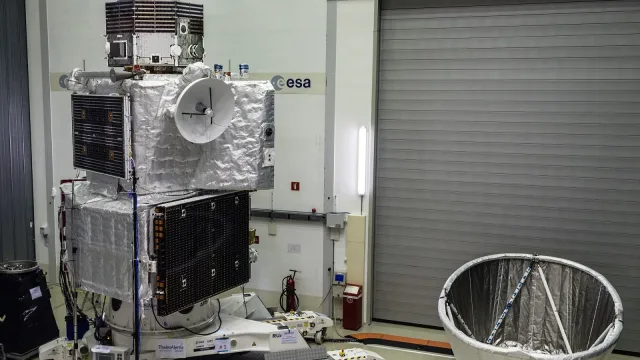
European Space Agency engineers have received the first close-up image from the Hera spacecraft as it inspects the site of a 2022 NASA planetary defense experiment, Mashable and Popular Science reported. The black-and-white photograph, taken from approximately 37 miles away, captures the previously unseen far side of the asteroid Didymos, located about 122 million miles from Earth.
In September 2022, NASA executed its Double Asteroid Redirection Test, known as DART, by crashing a 1,300-pound spacecraft into Dimorphos, a 500-foot-wide moonlet orbiting Didymos, at roughly 14,000 miles per hour, Popular Science reported. The collision altered the orbit of Dimorphos around Didymos by 33 minutes, a change larger than researchers had initially expected.
Hera, a car-sized probe launched by the European Space Agency, traveled for two years to reach the asteroid pair and conduct a detailed follow-up investigation, Mashable reported. While shadow conceals Dimorphos in the initial picture released on Nov. 5, Hera’s view of Didymos revealed a landscape covered with boulders, craters and grooves, as well as a ridge wrapping around the middle of the half-mile-wide asteroid.
Examining the Aftermath
“The first thing we said was ‘Wow!'” Hera principal investigator Patrick Michel said in a statement quoted by Mashable and Popular Science. “This feels like looking at a whole new world.”
Scientists are working to determine whether some of the features visible on Didymos were created by material thrown across the half-mile gap when DART slammed into Dimorphos. Mission scientist Michael Kueppers stated that researchers look forward to mapping all of the changes identified across both space rocks, Mashable reported.
When DART struck Dimorphos, the collision expelled dust and rock into space, generating a rocket-like thrust that scientists refer to as the “beta factor.” Hera will attempt to quantify this push, providing future mission planners with data on how much kinetic force is required to deflect hazardous asteroids that could threaten Earth.
Future Mapping and Interior Scans
Researchers also suspect the collision may have altered the movement of Dimorphos. Telescope observations indicate the smaller body may now be tumbling rather than keeping a single face pointed toward Didymos, according to Mashable.
To study the internal structure of the asteroid, Hera carries a smaller companion probe called Juventas. Juventas will use radar technology to scan the interior of Dimorphos, functioning similarly to an X-ray to determine if the moonlet is a single solid mass or a loose collection of boulders held together by weak gravitational forces.
The European Space Agency plans to publish more detailed high-resolution photographs of both Didymos and Dimorphos on Nov. 25 as Hera continues its orbital survey.