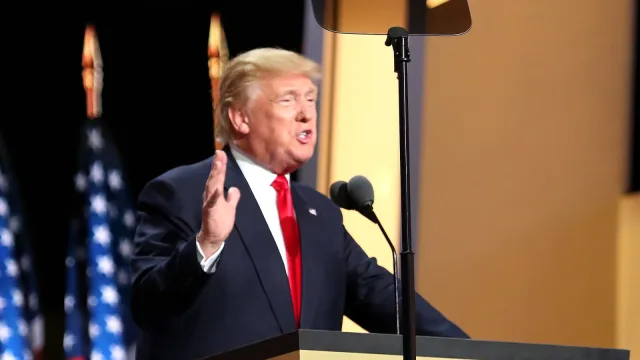
President Donald Trump has replaced National Cyber Director Sean Cairncross with Pentagon Chief Information Officer Kirsten Davies following a series of widespread computer outages that impacted government agencies and major U.S. corporations, ABC News reported.
Trump supported the leadership shift, telling reporters during a press conference that Cairncross was not performing well in the post, PBS reported. A source told ABC News that the president believed Cairncross lacked sufficient technical credentials to manage national cybersecurity strategy.
Widespread Disruptions Strike Key Sectors
The staff change follows weeks of technical disruptions across multiple critical U.S. sectors. Recent outages left millions of users without Microsoft email access, triggered a nationwide flight stoppage at the Federal Aviation Administration for several hours, disrupted customer transactions at JPMorgan Chase, and interrupted internal communication networks at the National Security Agency, PBS reported.
Trump administration officials emphasized that the technical glitches were not the result of malicious cyberattacks or state-sponsored activity. Instead, officials attributed the disruptions to recent software upgrades and system patches, according to ABC News.
AI Acceleration and Software Patching
Former Director of the Cybersecurity and Infrastructure Security Agency Christopher Krebs told PBS that the surge in software patches is directly tied to rapid advancements in artificial intelligence. Krebs pointed to frontier AI tools, such as Anthropic’s Mythos preview model released in April 2026, which allow developers to scan vast software codebases and locate security bugs far faster than human researchers.
Major technology companies, including Microsoft, IBM, and Google, are using these frontier AI models to discover and patch software vulnerabilities before foreign adversaries or hackers can exploit them, Krebs explained. However, deploying numerous security patches in rapid succession increases the risk of temporarily destabilizing networks.
Krebs added that while benign system updates cause short operational blips, offensive actors are also utilizing AI software frameworks, such as ARTEX, alongside open-source Chinese models like DeepSeek, Kimi, and GLM, to conduct continuous automated reconnaissance on digital infrastructure, PBS reported. Krebs noted that resolving these vulnerabilities through comprehensive patching could take a year or more.
Transition to New Cyber Leadership
Davies, who served as chief information officer at the Department of Defense, steps into the top White House cyber policy role with nearly two decades of technology industry experience. United States Director of National Intelligence Jay Clayton praised her appointment in a social media statement released by the White House rapid response team.
“With nearly two decades of leadership experience in the technology space, Kirsten Davies will be a strong asset for the Trump administration in her new position with the Office of the National Cyber Director,” Clayton wrote, noting he looks forward to working with her to navigate the evolving cyber landscape.
Krebs noted that the Office of the National Cyber Director at the White House is distinct from CISA, though both entities play critical roles in national security. In her new role, Davies is expected to focus on stabilizing critical infrastructure, working closely with major AI development laboratories, and identifying vulnerabilities across key digital networks, PBS reported.