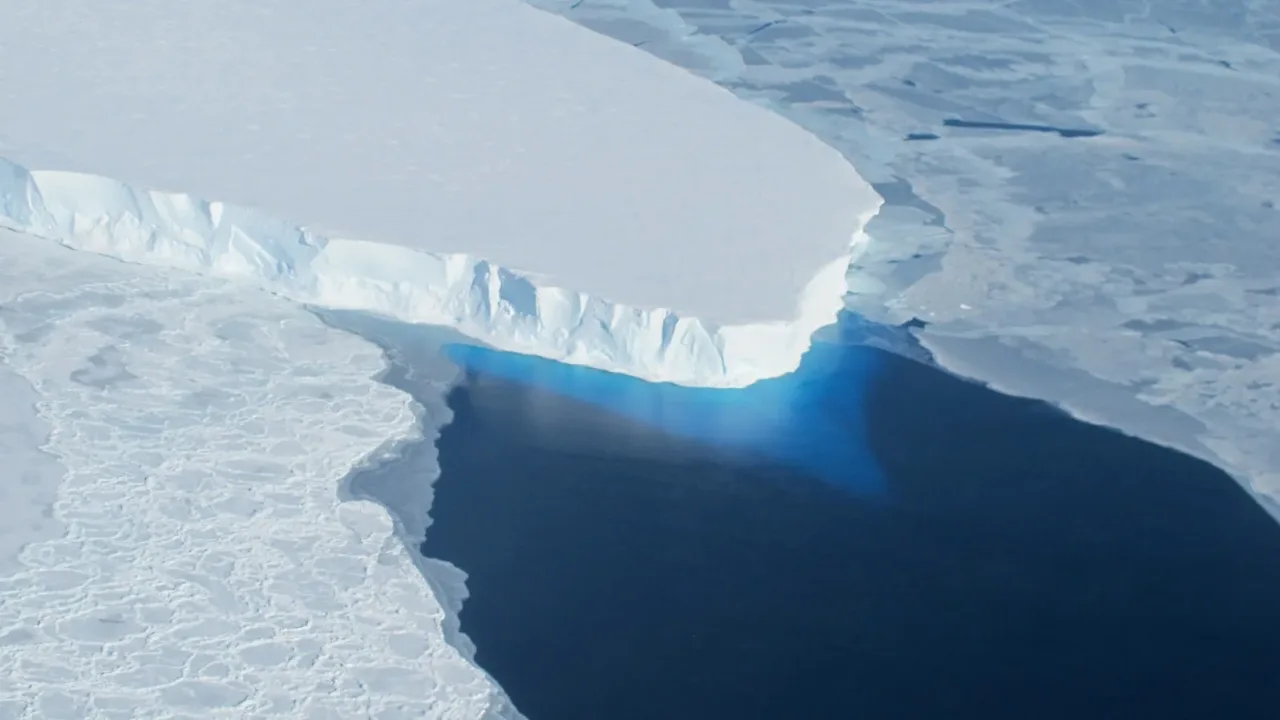
Warm ocean water pushing miles beneath Antarctica’s massive Thwaites Glacier could cause it to dump twice as much water into the ocean by the end of the century than previously projected, according to research published Monday in the journal Nature Communications.
Scientists from the University of California, Irvine, and NASA’s Jet Propulsion Laboratory found that pressurized seawater flushes deep inland beneath the ice in a process driven by tidal cycles. Incorporating this dynamic into computer models suggests the glacier could contribute up to 1.2 inches to global sea-level rise by 2100, even if ocean and air temperatures do not increase beyond their recent averages, CNN reported.
Flushing beneath the grounding zone
Glaciologists have long viewed the transition between ice resting on bedrock and floating shelf ice as a narrow, relatively stable boundary called a grounding line. However, satellite radar measurements from Finland’s ICEYE constellation revealed that Thwaites instead features a dynamic grounding zone that can span several miles, Gizmodo reported.
As ocean tides rise and fall, they lift the thick sheet of ice, allowing seawater to penetrate underneath in an action researchers described as tidal pumping. This brings ocean heat far inland, melting the glacier from its underbelly.
“We have documented and quantified the impacts of climate change on our planet’s sensitive ice sheets for decades, but a mounting realization gained in recent years of what is happening on the undersides of glaciers like Thwaites is leading to an even greater sense of alarm,” Eric Rignot, an Earth system science professor at UC Irvine and study co-author, said in a statement.
The study, led by UCLA project scientist Mattia Poinelli, evaluated the ice sheet using the Ice-sheet and Sea-level System Model. When scientists factored in a grounding zone between two and five kilometers wide, the simulations reproduced the retreat, thinning and ice velocity that satellites observed over the past quarter-century. Earlier international multi-model ensembles had projected an average contribution of roughly 15 millimeters to sea-level rise by 2100 under steady climate conditions, whereas the new model estimated up to 30 millimeters, or 1.2 inches, with an uncertainty margin of about 6 millimeters, according to Martin Cid Magazine.
Risk to stabilizing underwater ridges
Thwaites Glacier, often called the Doomsday Glacier due to the severe impacts its potential collapse would bring, holds enough ice to raise global sea levels by more than two feet on its own. Because it acts as a natural dam holding back the broader West Antarctic Ice Sheet, its complete disintegration could eventually raise ocean levels by around 10 feet, CNN noted.
The terrain beneath Thwaites slopes downward toward the interior of the continent, meaning ice loss exposes deeper areas to encroaching seawater. Currently, a submarine formation known as the Mouginot Ridge helps pin the glacier’s fastest-moving section in place about 950 meters below sea level.
According to the study, seawater intrusion is speeding up the detachment of ice from that barrier. In the simulations that most closely mirror current radar observations, the team calculated a 60 percent probability that the glacier will slip off the Mouginot Ridge before 2100. If unpinned, the ice could slide back toward the deeper interior basin with few obstacles until reaching the South Ridge.
Unknowns and future research
Outside experts emphasized that capturing these complex sub-ice dynamics is critical, though further verification is necessary. Ted Scambos, a senior research scientist at the University of Colorado Boulder, told CNN the research could prove to be “a real gamechanger for sea level forecasting from Thwaites.”
However, Robert Larter, a marine geophysicist with the British Antarctic Survey who was not part of the research team, cautioned that the environment underneath the ice shelf remains poorly sampled. He told CNN that researchers still face significant unknowns regarding subglacial processes and need more direct measurements to make firm forecasts.
To verify the model’s projections, researchers plan an expedition to the remote glacier in 2028 to install instruments capable of directly tracking seawater movements beneath the grounding zone.