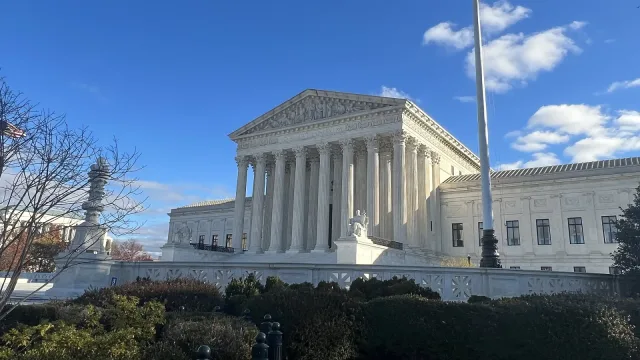
WASHINGTON — The Supreme Court is set to decide whether President Donald Trump can unilaterally shut down access to asylum at the U.S.-Mexico border, placing the administration’s aggressive immigration overhaul before the conservative majority.
The high court agreed to review lower federal court rulings that struck down an executive order signed on Trump’s first day back in office in January 2025. The proclamation declared the southern border situation an “invasion” and suspended entry and asylum claims for migrants covered by the order. Although two lower courts rejected the administration’s arguments, the ban has remained largely operational while legal appeals proceed, CNN and NPR reported.
Oral arguments on the asylum ban are anticipated in the spring, with a ruling expected by the end of June 2026. The justices will determine whether Section 212(f) of the Immigration and Nationality Act, which allows presidents to restrict noncitizen entry deemed harmful to national interests, gives the executive branch authority to completely block access to statutory asylum protections.
Multiple immigration challenges converge
The asylum case is part of a broader battery of legal battles facing the White House at the Supreme Court this term. On Dec. 9, the justices will hear arguments regarding the administration’s policy of deporting migrants to third countries without conducting individual human rights evaluations. Immigrant rights groups note that some migrants have been sent to nations like El Salvador, Nicaragua and Uganda, where they risk being returned to home countries where they face torture or death, according to NPR and CNN.
Later in the term, the court will also review the Justice Department’s vast expansion of mandatory detention. That policy subjects noncitizens who have lived inside the U.S. for years to mandatory holding, driving broad enforcement operations in major cities such as Chicago and Minneapolis.
“In all three of these cases, the Trump administration is trying to rewrite laws enacted by Congress, in service of a radical anti-immigrant agenda,” Cecillia Wang, an attorney with the American Civil Liberties Union, told CNN. White House spokeswoman Lauren Bis dismissed the critique, telling CNN that the ACLU prioritizes “criminal illegal aliens” over American citizens.
Dramatically lower border numbers and court purges
The policy shifts have fundamentally transformed the southern border and the nation’s immigration court system. U.S. Customs and Border Protection recorded fewer than 99,000 Southwest border apprehensions in fiscal year 2026 — a 95 percent drop from the more than 1.8 million annual apprehensions recorded during the Biden administration, according to federal data cited by NPR.
Inside immigration courtrooms, national asylum denial rates reached 94 percent in June, compared to roughly 50 percent in 2024, according to data compiled by Syracuse University’s TRAC research project. Critics attribute the rise to aggressive administration directives and sweeping personnel changes.
During Trump’s first year back in office, nearly 40 percent of immigration judges were fired or resigned, according to NPR. Over half of the current bench consists of Trump appointees, many of whom possess homeland security or military legal backgrounds rather than immigrant defense experience. Former Assistant Chief Immigration Judge Jennifer Peyton, who was terminated in July 2025, told NPR that judges are increasingly taught procedural shortcuts to curtail due process rights and issue expedited deportations.
Arguments over presidential power
Administration officials maintain that the asylum ban is essential to stem abuse of the legal system and prevent migrants from making false claims to gain entry while awaiting years-long proceedings. U.S. Solicitor General D. John Sauer warned the high court in filings that blocking the policy “threatens to revive the chaos along the southwest border,” CNN reported.
Conservative allies also expressed confidence that the high court will uphold the policy. Iowa Solicitor General Eric Wessan told CNN that lower courts have repeatedly misread federal statutes, predicting the Supreme Court is performing “cleanup” on lower court decisions.
However, advocates insist that federal law explicitly entitles individuals physically present in the U.S. to seek protection from persecution. Lee Gelernt, deputy director of the ACLU’s Immigrants’ Rights Project, told NPR that “the president does not have the right to unilaterally override the protections Congress has afforded those fleeing danger.”
With arguments scheduled for spring 2026, the forthcoming decisions will establish clear boundaries on executive authority over U.S. borders and determine the future of asylum in America.