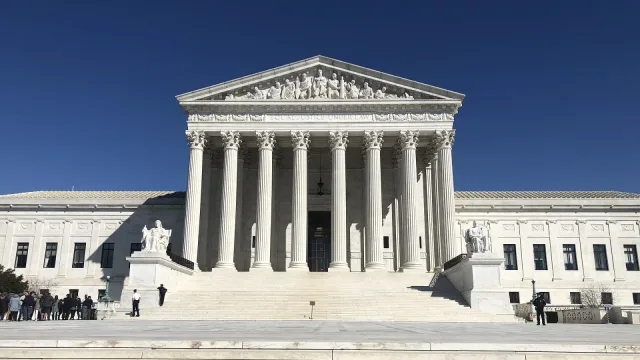
WASHINGTON — The Supreme Court is set to hear oral arguments Wednesday in a pair of Second Amendment cases that could determine whether state and local governments have the authority to ban AR-15-style semiautomatic rifles.
The consolidated disputes, originating from Connecticut and Cook County, Illinois, represent one of the most significant gun control legal fights to reach the 6-3 conservative high court in years. Lower federal appeals courts, including the 2nd U.S. Circuit Court of Appeals and the 7th U.S. Circuit Court of Appeals, had previously chosen to uphold the restrictions.
Arguments over common use and public safety
Opponents of the prohibitions argue that AR-15-style rifles are protected under the Constitution because they are widely owned across the country. Citing the Supreme Court’s landmark 2008 decision in District of Columbia v. Heller, which noted that weapons in “common use” cannot be prohibited, gun rights advocates point to surveys estimating that between 16 million and 26 million Americans own an AR-15 or similar firearm. Approximately 30 percent of American gun owners possess an AR-15 or similar rifle, according to one survey cited in court briefs. The Trump administration also supported the challengers’ stance in a legal brief filed in September.
Kostas Moros, legal research and education director at the Second Amendment Foundation, acknowledged the lethality of firearms while maintaining that constitutional protections remain intact. In their filings, plaintiffs described the AR-15 as a standard American rifle rather than an extraordinary weapon.
Conversely, state officials and gun control advocates maintain that lawmakers possess the right to restrict weapons designed to inflict mass casualties. Defense lawyers point to the weapon’s military heritage, noting its design origins linked to the M16 rifle, as well as its capacity for rapid semiautomatic fire and reduced recoil.
For officials in Connecticut, the legal defense is deeply tied to the 2012 massacre at Sandy Hook Elementary School in Newtown, where a gunman killed 20 first graders and six staff members. A brief submitted by former U.S. Solicitor General Elizabeth Prelogar, representing Connecticut, emphasized that AR-15-style rifles were utilized in 12 of the 17 deadliest mass killings in the United States since 2012. Currently, 11 states have enacted bans on these types of firearms.
Defenders of the measures argue that historical precedent supports banning unusually dangerous arms. Citing the high court’s 2022 decision in New York State Rifle & Pistol Association v. Bruen—which required gun laws to align with the nation’s historical traditions—lawyers for the government highlighted centuries of legal history, including English and early American bans on dangerous weapons such as medieval launcegays, crossbows, and concealed daggers.
“The basic function of government is to keep its citizenry safe, and these guns are so incredibly dangerous in a densely populated area like Chicago,” Cook County State’s Attorney Eileen O’Neill Burke, a Democrat, said in defending her county’s restriction.
Procedural maneuvers and court dynamics
Ahead of next week’s argument, the justices deferred a request from Cook County to dismiss its case as moot. The procedural issue arose after lead plaintiff Cutberto Viramontes filed a motion in late October seeking to withdraw from the litigation without public explanation. Cook County argued that another remaining plaintiff, Christopher Khaya, initially sought a different firearm model. However, lawyers representing the challengers countered that Khaya also desires to purchase an AR-15 platform rifle, prompting the justices to postpone resolving the mootness claim until after oral arguments.
The outcome is expected to hinge on how the conservative justices interpret prior precedents. At least four conservative members—Justices Clarence Thomas, Samuel Alito, Neil Gorsuch, and Brett Kavanaugh—have previously signaled varying degrees of skepticism toward bans on semiautomatic rifles. Legal analysts note that attention during Wednesday’s session will focus heavily on Chief Justice John Roberts and Justice Amy Coney Barrett, whose votes could prove decisive in shaping the future of assault weapon regulations nationwide.