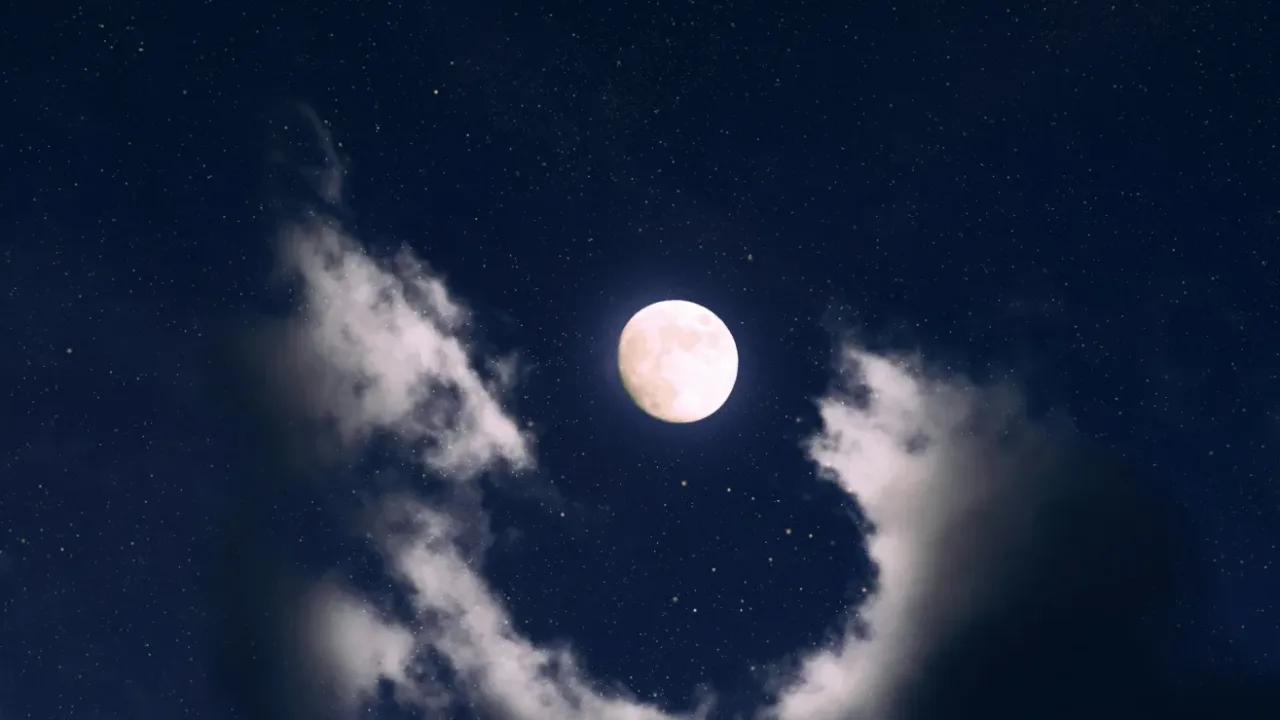
Sky-watchers across the U.S. can look up Tuesday evening to observe the November beaver moon supermoon, the first in a series of three consecutive full supermoons that will brighten the night sky into early 2027. According to EarthSky data cited by CNN, the full moon reached its peak illumination at 9:54 a.m. Eastern Time. While that exact moment fell during daylight hours across the United States, the moon will remain visually full through Tuesday and Wednesday evening, NASA scientist Noah Petro said.
What makes the beaver moon a supermoon
The term “beaver moon” traditionally refers to November’s full moon, marking the time of year when dam-building mammals prepare for winter, CNN reported. This month’s event also qualifies as a supermoon, an occurrence that happens when a full moon coincides with perigee, the point in the moon’s elliptical orbit where it is closest to Earth.
According to NASA, a supermoon occurs whenever a full moon takes place within 90 percent of its closest approach to Earth, the BBC reported. While supermoon is a widely recognized popular label, astronomers formally describe the alignment as a perigee-syzygy of the sun, Earth, and moon, according to Devon Salasin, head astronomer and area manager at Stargazing Moab, in comments to National Geographic.
Because the moon’s orbit is elliptical rather than circular, its distance from Earth varies continuously, explained Kevin Lewis, vice chair and professor of Earth and planetary sciences at Johns Hopkins University. Lewis told CNN that supermoons often happen in clusters of three or four because the moon completes its orbital return to perigee in roughly 27.5 days, while a full phase cycle takes about 29.5 days. Those overlapping time frames allow full moons to align near perigee several months in a row.
How to view the celestial display
Petro, chief of NASA’s Planetary Geology, Geophysics and Geochemistry Lab at Goddard Space Flight Center in Maryland, told CNN that November’s supermoon will appear roughly 17 percent larger and 30 percent brighter than the smallest full moon of the year. He added that people who regularly watch full moons will likely spot the difference.
No special astronomical equipment is necessary to view the supermoon. However, NASA notes that using binoculars or a small telescope can help viewers see finer details across the lunar surface, including craters and dark plains formed by ancient lava flows known as lunar seas.
For optimal viewing, Petro recommended seeking out a dark location away from bright city lights, tall buildings, and dense tree lines. Scientists and astronomers note that the moon appears especially dramatic shortly after sunset, when it sits low on the horizon. This visual effect is known as the moon illusion. While scientists have not fully explained the optical illusion, NASA noted it may stem from how the human brain processes visual information when comparing the moon to foreground objects like trees and rooftops.
Upcoming supermoons and sky events
Beyond its visual impact, a supermoon slightly increases the moon’s gravitational pull on Earth, creating higher ocean tides than normal around the full moon phase, according to reports from the BBC and CNN.
This week’s spectacle is the first in a trio of consecutive supermoons. The second will arrive on Dec. 23 with the cold moon, which The Old Farmer’s Almanac projects will be the largest and brightest supermoon of 2026, CNN reported. The sequence will conclude on Jan. 22, 2027, with the wolf moon supermoon.
Sky-watchers can also look out for additional celestial activity this month. The American Meteor Society noted that the Leonid meteor shower will remain active through Nov. 30, offering opportunities to spot remaining fireballs across the night sky before two more meteor showers peak before the end of the year.