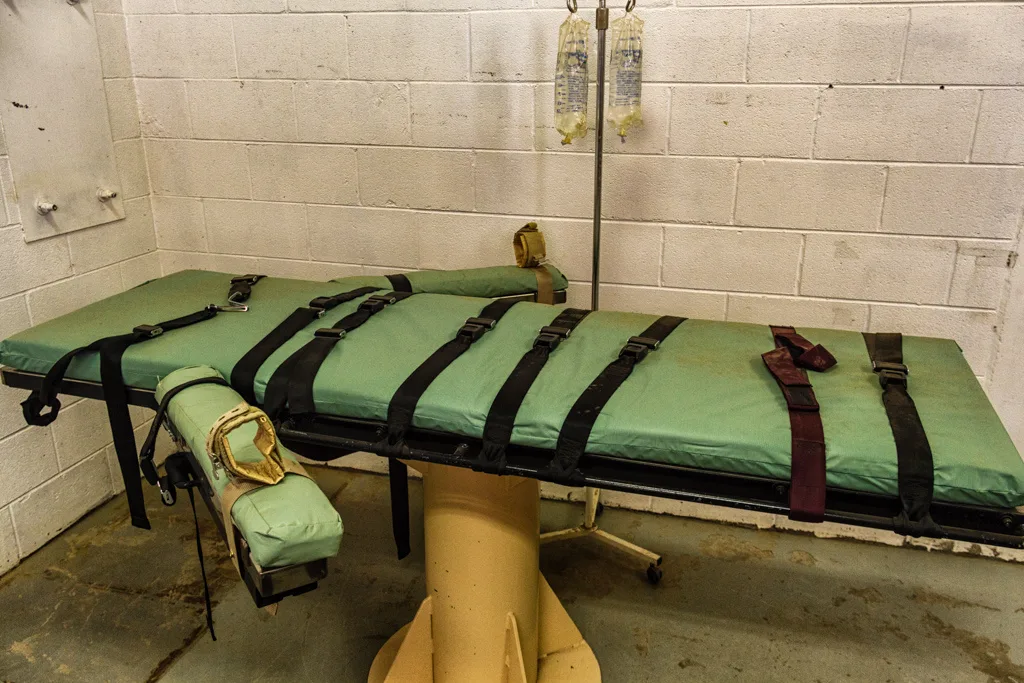
Tennessee officials are facing intense scrutiny over state execution protocols and department leadership after death row inmate Christa Pike survived a lethal injection attempt on Sept. 30, prompting an official review and a halt to executions across the state.
Pike, 50, became the first death row inmate in the U.S. to survive lethal injection after receiving two doses of pentobarbital at a Nashville prison. Following the failed procedure, Republican Gov. Bill Lee halted all scheduled executions for the remainder of the year and initiated an independent investigation into state execution procedures.
Hospital Recovery and Legal Battles
Pike was taken to a Nashville hospital and placed on life support, but she has since regained consciousness and begun speaking, CNN reported. In a court filing, her attorney Luke Ihnen confirmed that handcuffs had been taken off Pike in the hospital, though one foot remained shackled to her bed under the guard of three armed officers, according to the New York Post. Her legal team has urged Lee to commute her sentence to life in prison without parole, arguing she endured profound trauma and should not face another execution attempt.
Pike was condemned to death for the 1995 killing of Colleen Slemmer. Her defense team had previously cautioned prison staff about severe vein damage that would complicate intravenous access. During the execution attempt, personnel inserted at least seven needles, bending one at a right angle, before the pentobarbital caused swelling and blistering on her arms, her attorneys stated in court records cited by CNN. On Wednesday, a judge granted an emergency motion directing the state to preserve all records and physical materials related to the procedure.
Scrutiny of Leadership and Arizona Parallels
The fallout intensified when Tennessee Department of Correction Commissioner Frank Strada announced his resignation on Oct. 3. Reporting by NPR revealed that Strada had previously served as a top prison administrator in Arizona during three botched executions there.
Retired federal Judge David Duncan, who reviewed Arizona’s procedures at the request of Arizona Gov. Katie Hobbs, uncovered extensive problems under Strada’s tenure, NPR reported. Duncan discovered that Arizona officials kept pentobarbital in an unlabelled refrigerator jar, instructed staff members to consult Wikipedia for dosage guidelines, and paid cash to participating physicians. Duncan told NPR that extreme secrecy prevented personnel from establishing best practices.
Tennessee adopted a single-drug pentobarbital method and a revised protocol in 2023, shortly after Strada arrived. Legal records show sections of Tennessee’s guidelines governing intravenous access teams closely mirror the Arizona rules, according to NPR. The state previously called off an execution attempt involving inmate Tony Carruthers on May 21 after personnel repeatedly failed to place intravenous lines.
Constitutional Questions and Next Steps
Federal attorney Kit Thomas, who filed suit against Tennessee prison officials over execution transparency, told NPR that officials have long refused to disclose information regarding staff training, drug sourcing, and storage practices. Meanwhile, the failed attempt has sparked intense political debate across Tennessee, with candidates in the upcoming gubernatorial contest split between enacting execution moratoriums and seeking alternative capital punishment methods.
Legal scholars question whether Tennessee can legally attempt another execution of Pike under the Eighth Amendment’s prohibition against cruel and unusual punishment. The state has not indicated whether it will seek a new execution date once its independent investigation concludes.