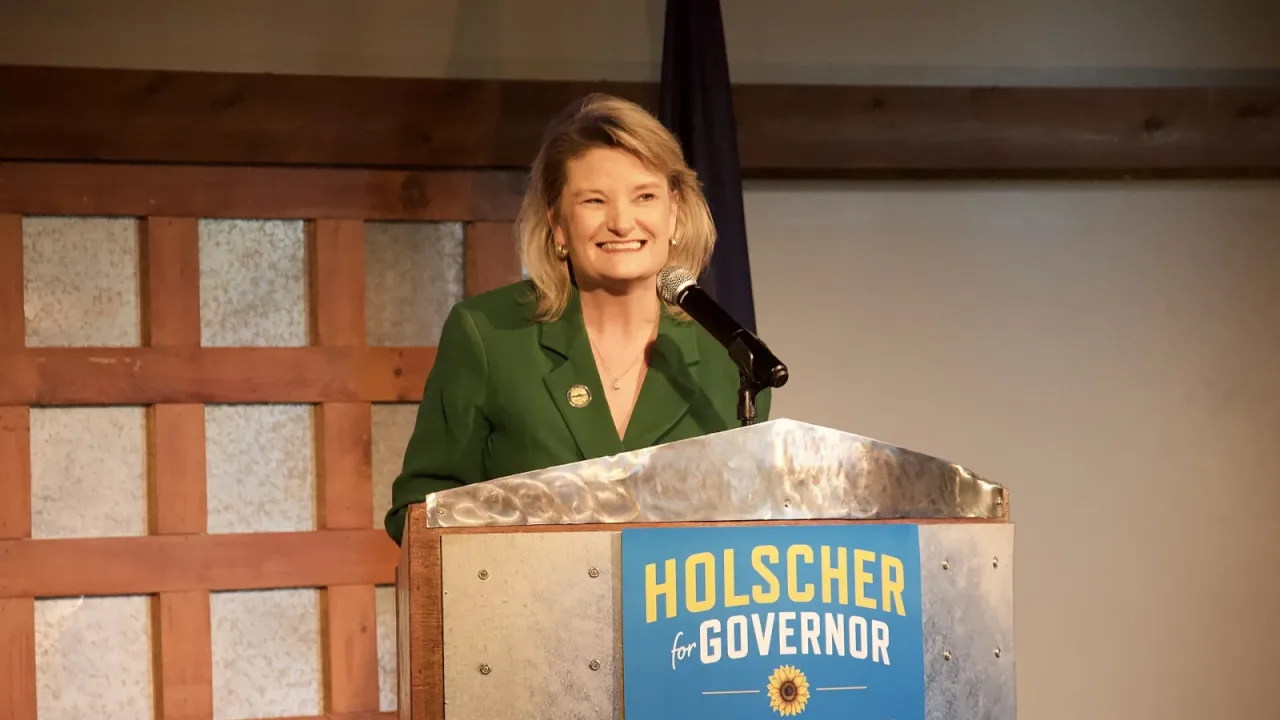
TOPEKA, Kan. — Democratic state Sen. Cindy Holscher won the Kansas governor’s race on Thursday, holding onto the executive mansion for her party by defeating Republican Kansas Senate President Ty Masterson, The Associated Press projected. The victory marks the third consecutive term Democrats have won the governorship in a state that has reliably backed Republican presidential candidates for decades.
Holscher, 57, will succeed term-limited Democratic Gov. Laura Kelly, who served eight years after winning elections in 2018 and 2022. NPR reported that of the 36 gubernatorial contests nationwide this year, Kansas was viewed as the state most vulnerable to flipping from Democratic to Republican leadership.
Campaign Clashes and Key Issues
The open contest featured sharp policy contrasts between the two state senators. Holscher, a former Sprint Corp. manager who entered the Kansas House in 2016 before joining the state Senate in 2021, campaigned on populist themes. According to NPR, she pledged to block tax breaks for billionaires, place a temporary ban on constructing new artificial intelligence data centers, and legalize cannabis to boost state revenues. She also opposed public funding for private school vouchers and criticized Masterson over past income tax cuts passed during former Republican Gov. Sam Brownback’s administration.
Masterson, 57, who has served as state Senate president since 2021, positioned himself as a staunch conservative. Endorsed by President Donald Trump during a contested August primary, Masterson focused his campaign on reducing property taxes, supporting private school vouchers, and boosting agriculture, energy, and business interests, NPR reported. Masterson criticized Holscher’s policy positions as radical, while Holscher dismissed his attacks as empty labels.
Republican groups heavily financed Masterson’s campaign. The New York Post reported that the Republican Governors Association spent $19 million on digital and television advertisements, outspending Democratic organizations more than 3-to-1 overall. Fox News noted that Holscher also faced scrutiny over 2023 social media posts made during a debate regarding restrictions on drag performances.
Electoral Map and State Dynamics
Holscher’s path to victory relied heavily on strong turnout in suburban Johnson County, the state’s most populous county containing 23 percent of Kansas voters. According to the New York Post, Holscher secured over 60 percent of the vote in Johnson County, offsetting strong margins for Masterson in rural areas.
The victory capped a notable election night for Kansas Democrats. U.S. Sen.-elect Adam Hamilton, a Methodist pastor from Johnson County, secured the party’s first U.S. Senate seat in Kansas since the 1930s, according to The New York Times. In addition, Democratic challenger Chris Mann defeated incumbent Republican Attorney General Kris Kobach, and Democrats gained seats in the Kansas House of Representatives to break the GOP’s veto-proof supermajority, The New York Times and the New York Post reported.
What Comes Next
Holscher had previously declared victory on Tuesday before the official projection on Thursday, writing on social media that preparing to lead had already begun, the New York Post reported. Masterson conceded the race in a post on social media and called Holscher to congratulate her, according to Fox News. Masterson stated he will return to his post as state Senate president in January, where he intends to focus on tax relief, public safety, and educational funding alongside the Republican-controlled legislature.