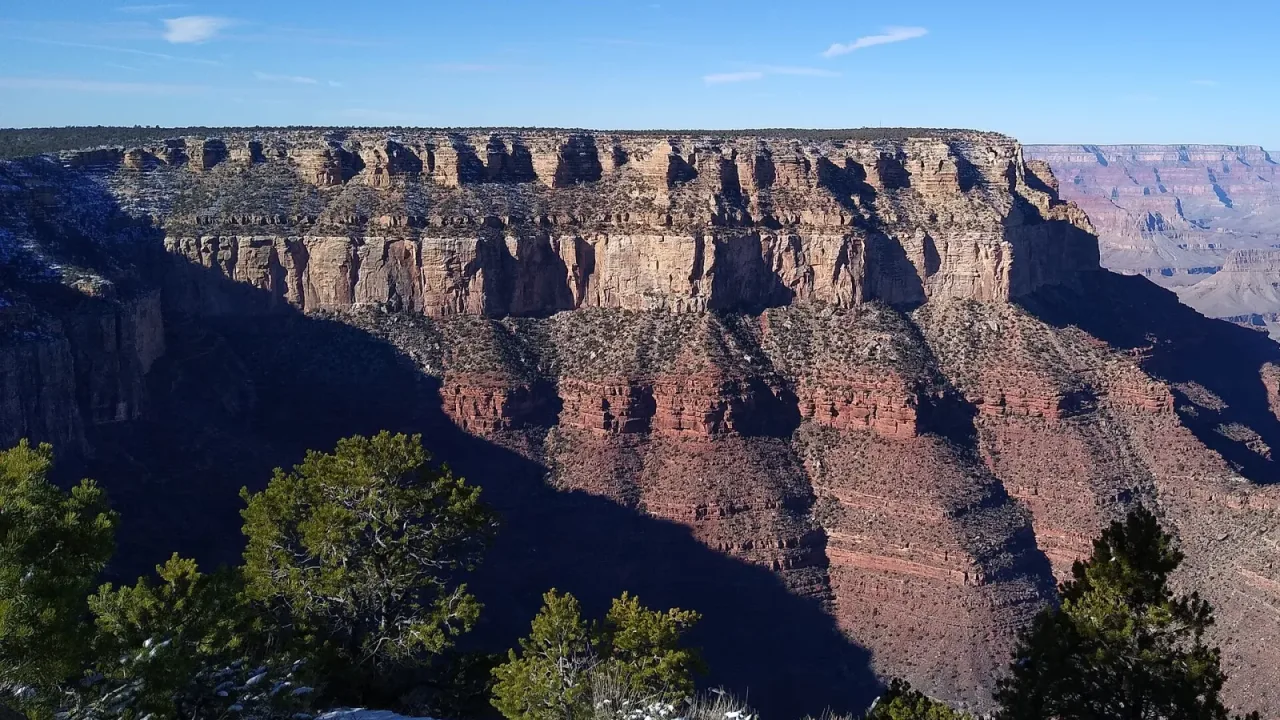
A massive gap spanning more than a billion years of geological history in the Grand Canyon and other regions worldwide may have been driven by slow, churning movements deep within the Earth, according to research published Nov. 4 in the journal Nature.
In the walls of the Grand Canyon, 1.7 billion-year-old metamorphic and igneous formations rest directly beneath sedimentary rocks deposited 500 million years ago. This missing period of 1.2 billion years, known to geologists as the Great Unconformity, is also visible across North America, northern China, and Europe’s Baltic region. While scientists have long debated what wiped out these ancient rock layers, new computer simulations point to thermal currents inside the planet’s mantle as the primary catalyst, Live Science reported.
Study co-authors Santosh Dhungana and Nicolas Flament of the University of Wollongong in Australia used computer models to simulate how Earth’s middle layer moved over the past billion years during the breakup and formation of ancient supercontinents. Their findings show that heat-driven mantle circulation lifted large landmasses upward during the time the gap was formed.
How mantle shifts created and preserved the gap
The upward movement of land exposed ancient rock formations to intense weathering, glaciations, and ocean forces, causing sediments to slough off the continents into surrounding waters. According to the study, five out of six mantle-convection cases modeled by the researchers generated a distinct cycle of uplift followed by subsidence for Laurentia, the ancient core of North America.
“Glaciation probably played a major role in erosion,” Flament told Live Science, noting that without mantle uplift pushing the continents higher, glaciers and weather would have lacked the slope necessary to drag sediments downward.
Crucially, the simulations demonstrated that roughly 540 million years ago, the mantle dynamics shifted. The regions began sinking rather than rising, creating low-lying areas where fresh sediment could gather and pile up in neat layers on top of the eroded surfaces. This transition to sediment deposition allowed the boundary to be locked in place and preserved in the geological record.
Setting the stage for complex life
The missing timeline occurred just before and during the Cambrian explosion, a period marked by a rapid expansion and diversification of complex animal life in Earth’s oceans. Geologists note that the physical processes driving the Great Unconformity may have helped set the environmental stage for this biological surge.
Shanan Peters, a geologist at the University of Wisconsin-Madison who was not involved in the study, explained to Live Science that exposing ancient crystalline rocks to weathering likely washed essential elements like potassium, iron, manganese, and carbon into ancient seas. This influx of nutrients may have prompted early marine organisms to develop protective shells through biomineralization and contributed to a more oxygen-rich atmosphere, Peters told the outlet.
Researchers emphasize that the mantle model offers a compelling mechanism for global land movement, though questions remain about continental movements in other regions. Flament said he hopes to test the model against expanding rock layer databases in Africa and Russia to determine whether the findings hold true globally.