Health authorities in the Democratic Republic of the Congo administered the first doses in an emergency clinical trial on Friday to combat the country’s deadliest Ebola outbreak on record, global health officials announced.
The study, known as the Tumaini trial, began in Bunia, the capital of Congo’s northeastern Ituri province, according to the World Health Organization and the Coalition for Epidemic Preparedness Innovations. Tumaini means “hope” in Swahili. The trial opened as the death toll from the epidemic approached 4,700, driven by the rare Bundibugyo strain of the virus, for which no licensed vaccine currently exists.
Evaluating cross-protection and new vaccines
Participants in the trial received the Ervebo vaccine, an immunization already approved for the related Zaire strain of Ebola, Al Jazeera reported. Scientists are conducting the human trial to evaluate whether the existing shot produces cross-protective immunity against the Bundibugyo virus.
“This trial will help us understand whether any of the vaccine candidates designed for Bundibugyo virus work,” WHO Director-General Tedros Adhanom Ghebreyesus wrote on social media, noting that the agency is backing the Congolese-led initiative.
The adaptive trial format allows multiple formulas to undergo evaluation simultaneously. In addition to Ervebo, two experimental vaccines designed specifically for the Bundibugyo species are scheduled to join the trial soon, CEPI said. One is an mRNA-based candidate created by the U.S. biotechnology company Moderna, and the other is a viral-vector jab engineered by the University of Oxford and the Serum Institute of India.
Researchers are employing a ring vaccination strategy, an approach that prioritizes individuals who have had direct contact with confirmed Ebola patients, as well as the contacts of those individuals. The study protocol includes pregnant women and children aged 12 and older, groups that are frequently left out of clinical research during emergency outbreaks.
Massive strain on health systems
The Congolese government declared the epidemic on May 15. The outbreak has since evolved into the fastest-spreading Ebola crisis in the nation’s history, spanning eight provinces. According to Yahoo News, more than 9,700 confirmed cases and 4,687 deaths have been documented, with roughly 10 percent of those fatalities occurring over the past two weeks alone.
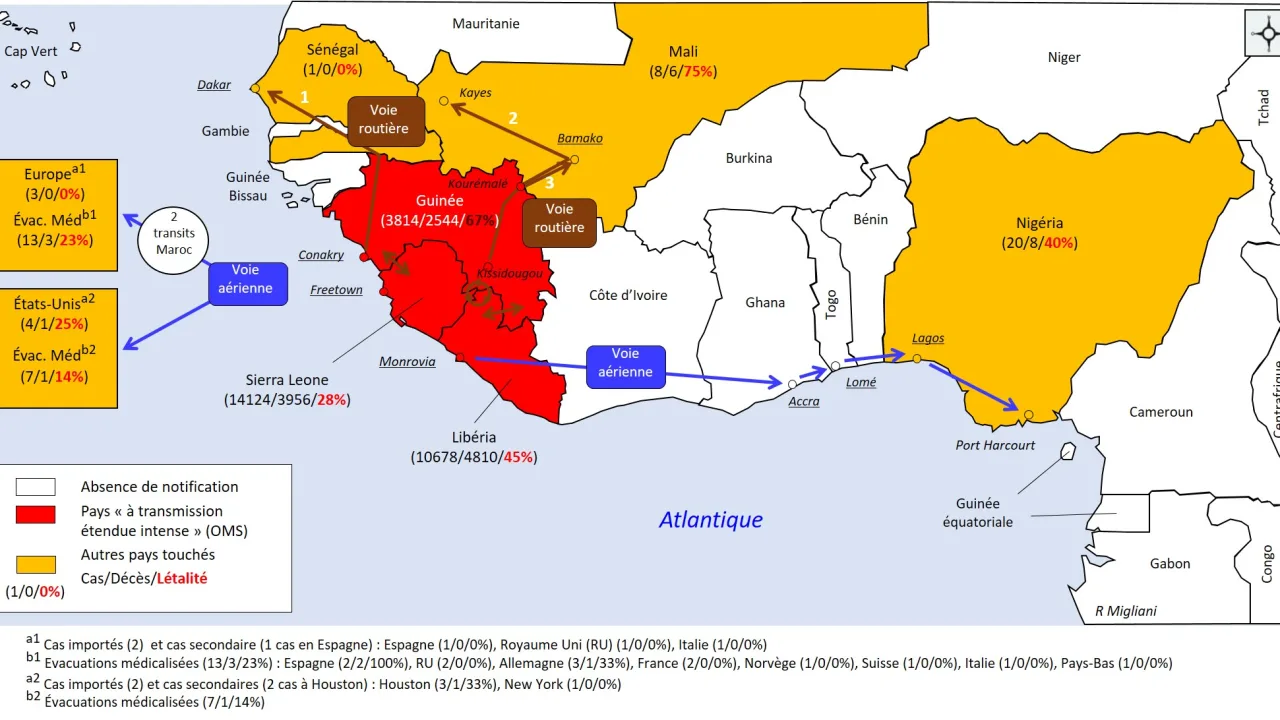
The disease has also extended beyond Congo’s borders. Cases have surfaced in Uganda, Kenya and Nigeria, while Yahoo News reported five countries have identified infections, including an imported case in France. The regional spread prompted both the WHO and the Africa Centres for Disease Control and Prevention to declare public health emergencies earlier this year.
Containment teams face significant logistical and social hurdles in Ituri, which remains the central focus of transmission with over 7,000 confirmed cases. Health workers have struggled with limited supplies, remote terrain and active regional armed conflicts, Yahoo News reported. Response workers also encounter local distrust, rooted in persistent community suspicions surrounding international aid operations.
Contact tracing has attained an average follow-up rate of nearly 80 percent, the WHO reported, falling short of the 95 percent benchmark that epidemiologists consider necessary to break chains of transmission.
Scientific collaboration and next steps
The Tumaini trial is co-sponsored by Congo’s National Institute of Biomedical Research and the University of Antwerp in Belgium, alongside backing from Doctors Without Borders, the European Commission and the U.S. Department of State.
To accelerate product availability if trials prove successful, Gavi, the Vaccine Alliance, has pledged up to $40 million to finance manufacturing readiness, CEPI announced. Regulators from the African Medicines Agency and the European Medicines Agency have also issued joint guidance to permit expedited regulatory reviews for candidate vaccines.
Investigators plan to begin enrolling additional trial participants in the coming weeks as laboratory teams analyze immune responses to determine whether the shots provide effective defense against the virus.