Earth’s metallic core has been steadily transferring ancient materials into the surrounding mantle across billions of years of geological history, according to a study published in the journal Science Advances.
Geoscientists at the University of Science and Technology of China in Hefei sought to resolve a long-standing question about the planet’s interior: whether chemical anomalies deep within the mantle are preserved remnants from Earth’s original solidification, or proof of active, ongoing chemical trades between the core and mantle.
Tracking Quantum Movement Beneath the Crust
To analyze the problem, the research team deployed path-integral computer simulations augmented by machine learning to examine the quantum behavior of molecules and atoms under extreme conditions, ScienceAlert reported. Their primary focus centered on the movement of hydrogen, an element so lightweight that its transport through deep rock layers is heavily influenced by quantum mechanics.
The scientists tracked the deuterium-to-hydrogen ratio, which measures the balance between a heavier isotope of hydrogen and its standard form. When Earth was young and covered by a global magma ocean, the crystallization process would have had a very weak separating effect on these isotopes, according to the team’s models.
As a result, that initial cooling phase should have left the early mantle with a uniform isotopic signature, regardless of fluctuations in pressure, temperature, or starting water volume. “Collectively, these results indicate that magma ocean crystallization yields a primitive mantle with an essentially homogeneous hydrogen isotope composition, despite large variations in pressure, temperature, and model assumptions,” the authors wrote.
Evidence in Volcanic Rocks
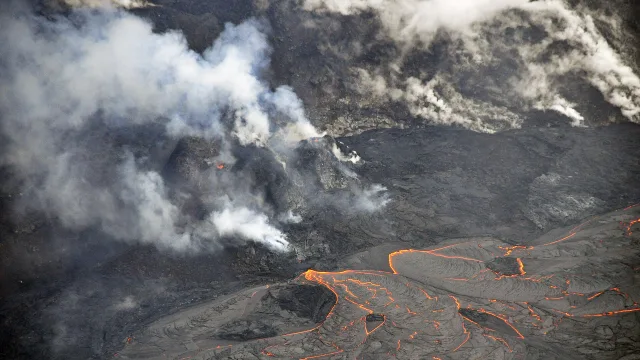
Because the initial magma ocean would have produced an even isotopic spread, modern variations point toward another source: the core itself. The researchers examined ocean island basalts, which are volcanic lavas formed by hot plumes originating near the core-mantle boundary. Examples of these formations include lavas on Baffin Island in Nunavut, Canada, as well as across Iceland.
These erupted rocks display a lower ratio of deuterium to hydrogen, signaling an upward influx of light hydrogen that was originally drawn into Earth’s core from the early solar nebula during the formation of the Solar System. Once this hydrogen escapes from the metallic core, it travels into the mantle and crust, becoming integrated into minerals.
The researchers noted that other chemical signatures reinforce this mechanism:
- Elevated ratios of helium-3 to helium-4 in surface basalts, with the lighter helium-3 representing primordial material trapped during Earth’s earliest days.
- Traces of tungsten isotopes, a dense metal mostly locked inside the core during planetary formation that now travels upward within rising mantle plumes.
The study authors concluded that current isotopic readings in the lower mantle are “unlikely to represent simple relics of early differentiation.” Instead, they wrote that these deep chemical fingerprints “reflect dynamic modification by ongoing core-mantle exchange throughout Earth’s evolution.”
While the findings show that the boundary separating the core and mantle is far more permeable than previously assumed, geoscientists are still investigating the precise rate at which these primordial reservoirs are depleting and how deep-seated chemical plumes will continue to reshape Earth’s interior over the next several billion years.