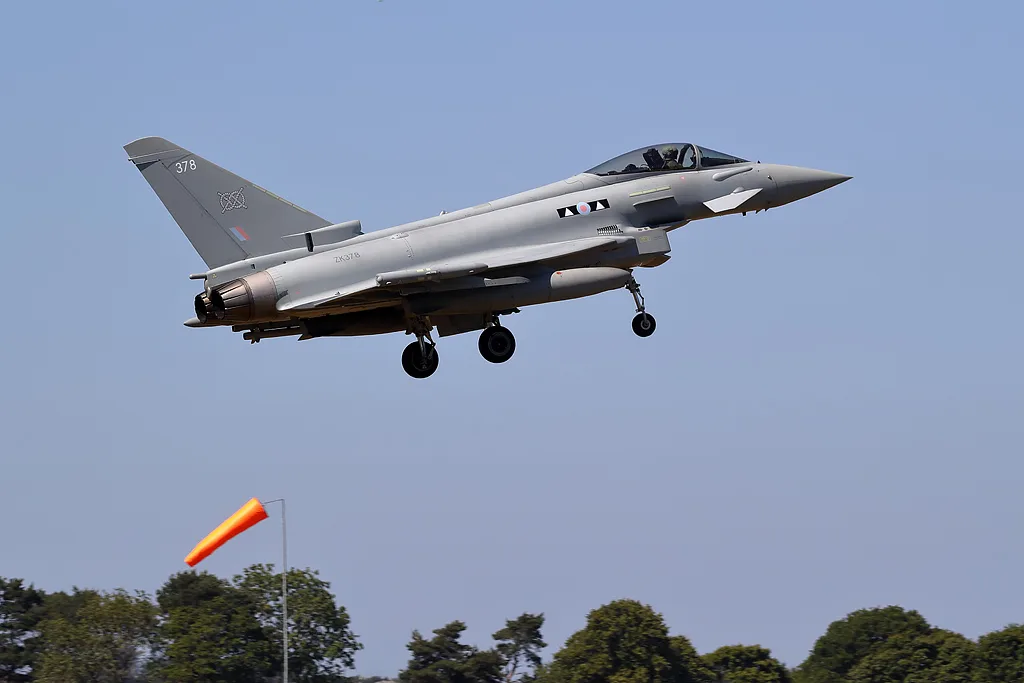
Britain announced Tuesday that it will deploy Royal Air Force fighter jets to help defend Saudi Arabia against escalating missile and drone attacks by Yemen’s Houthi rebels, marking a significant expansion of Western military involvement in the widening Gulf conflict.
The British Ministry of Defence said RAF Typhoon warplanes will carry out defensive missions over Saudi airspace to protect civilian population centers and vital infrastructure. Officials emphasized that the operation remains strictly protective and will not involve offensive sorties against Houthi positions inside Yemen.
A defensive deployment
British Defence Secretary Wes Streeting said the mission follows formal requests from Riyadh after intensified rebel bombardments across the kingdom’s borders. Streeting described the attacks against Saudi Arabia as “absolutely despicable,” highlighting recent strikes that hit King Khalid International Airport in Riyadh.
“RAF Typhoons will fly defensive air missions to help protect Saudi airspace from drones and missiles,” Streeting said in a statement. He added that the deployment builds upon existing British personnel and equipment stationed in the region.
Alongside the Typhoons, the U.K. will dispatch an Airbus Atlas A400M transport aircraft to assist in shifting military supplies within Saudi Arabia, as well as military advisers to assist Saudi staff officers. Britain also agreed to extend an ongoing air-to-air refueling mission using an RAF Voyager tanker by 90 days, according to reporting by The Guardian.
Prime Minister Andy Burnham had indicated earlier this month that the British government was open to providing increased assistance to Riyadh amid mounting instability.
Deadly cross-border escalation
Cross-border violence between the Iran-aligned Houthis and the Saudi-backed Yemeni coalition has surged sharply in recent weeks. Strikes targeting the Saudi capital’s commercial airport and oil installations owned by state energy firm Saudi Aramco have rattled international markets, pushing crude oil prices above $100 per barrel.
A missile strike on the Riyadh airport killed 13 people, contributing to at least 19 deaths recorded inside Saudi Arabia since September, The Guardian reported.
Inside Yemen, the fighting has exacted a much heavier toll. Accounts differ regarding the casualties of a Monday missile barrage directed at a government military training facility in southern Yemen. Authorities initially reported 58 deaths, while Al Jazeera reported at least 53 fatalities from three ballistic missiles, and The Guardian later reported the death toll had climbed to 73.
Allied hesitations and economic fallout
British officials linked the military intervention directly to economic concerns, warning that supply disruptions in the Gulf threaten to drive up household energy costs and fuel inflation across the U.K. Al Jazeera reported that domestic energy anxiety played a major part in driving London’s decision.
The move comes as other international partners proceed cautiously. The British announcement followed discussions between Streeting and U.S. Defense Secretary Pete Hegseth at the Pentagon, The Guardian reported. While Washington has dispatched more than 100 military advisers and enhanced intelligence sharing, U.S. officials have expressed reluctance to engage in deeper direct military action, with U.S. envoy Tom Barrack characterizing ground deployments against the Houthis as fruitless.
Regional efforts to mobilize support have also seen delays. Egypt’s parliament postponed for a second time a vote authorizing President Abdel Fattah el-Sisi to commit military assistance to Saudi Arabia, rescheduling the session for Oct. 26, according to Egyptian state media.
Security analysts have raised questions over how effectively the British mission will navigate the battlefield. H.A. Hellyer, a Middle East specialist at the Royal United Services Institute, warned that defining defensive parameters could prove challenging if British forces intercept attacks over regional waterways, while noting that British air cover could simultaneously free up Saudi aircraft to intensify their own offensive operations.