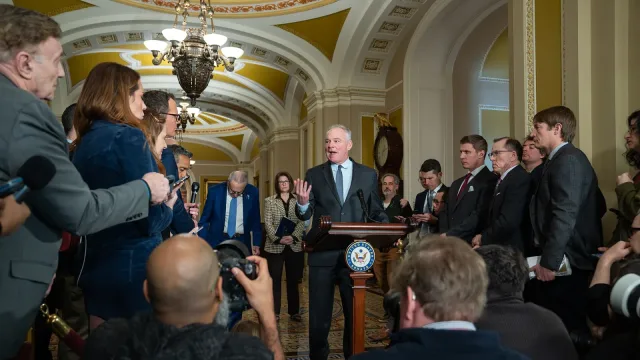
WASHINGTON — The Senate voted 62-33 on Thursday night to pass a major bipartisan bill aimed at simplifying environmental reviews and accelerating energy and infrastructure construction across the United States.
The measure, officially named the Bipartisan American Affordability and Jobs Act of 2026, represents a yearslong effort to break regulatory bottlenecks delaying power plants, pipelines, wind and solar installations, and electrical transmission lines. Sponsored by a bipartisan group of senators including Shelley Moore Capito, R-W.Va., Sheldon Whitehouse, D-R.I., Mike Lee, R-Utah, and Martin Heinrich, D-N.M., the bill now heads to the House of Representatives for consideration.
Speeding Up Reviews and Targeting Data Centers
The legislation sets strict review deadlines for federal agencies, limits legal challenges to approved projects and restricts regulators from revoking existing permits. Proponents argue these changes are necessary to lower electricity prices and expand the power grid to keep up with surging energy demand.
“If we want life to be more affordable in America, we need to make it more affordable to build in America, but also more convenient — more efficient,” GOP Sen. John Barrasso of Wyoming said on the Senate floor ahead of the vote.
To address growing concerns over power consumption from technology infrastructure, the bill includes targeted requirements for large data centers. Any facility with an energy demand of 20 megawatts or more will be required to pay the full incremental cost of the infrastructure required to serve it, preventing utility companies from passing those construction expenses onto residential ratepayers.
Heinrich emphasized that the language provides binding consumer protections. “It will mean that we actually require big load centers, whether that’s a factory or a data center, to not pass those costs on to the American consumer by statute,” he said.
Bipartisan Support and Environmental Backlash
The final vote saw 15 members of the Democratic caucus, including Senate Minority Leader Chuck Schumer, join almost all Senate Republicans in favor of the package. Two Republicans, Sens. Josh Hawley of Missouri and Mike Rounds of South Dakota, voted against it, alongside 31 Democrats.
Opponents, including progressive lawmakers and environmental organizations, expressed deep concern that the measure weakens foundational environmental statutes like the National Environmental Policy Act, Clean Water Act and Endangered Species Act. Critics argued that streamlining reviews will expand fossil fuel production and increase pollution in vulnerable communities.
“Getting more renewable electrons where they are needed doesn’t tackle climate change if you simultaneously promote the burning of more fossil fuels,” Democratic Sen. Jeff Merkley of Oregon said, warning that the bill opens new avenues for carbon emissions.
Native American leaders and several West Coast senators also cited threats to tribal sovereignty and sacred lands, warning that accelerated permitting timelines bypass meaningful consultation with tribal governments.
Uncertain Path Ahead in the House
President Trump has urged lawmakers to pass the package, calling it a major win for domestic energy dominance and affordability. However, the bill’s prospects in the House remain uncertain as leaders navigate competing priorities and attendance challenges.
House Minority Leader Hakeem Jeffries indicated through a spokesperson that while he supports permitting reform, the Senate measure falls short in key areas and requires further negotiation. Meanwhile, House Majority Leader Steve Scalise expressed optimism about getting a final bill to the president’s desk, though it remains unclear whether the lower chamber will accept the Senate version without changes.
Senate Majority Leader John Thune, R-S.D., urged House members to pass the legislation promptly without further amendments. “The best way to get anything done around here is for them to pick up the bill and pass it,” Thune said after the vote.